









- Country: Korea
- Initial release: 2024 (Korea)
- Film Director: Jae-hyun Jang
- Genre: Suspense, Horror, Dark
- Rate: 18+
- Original Language: Korean
- Subtitle: English
- Running Time: 134 Minutes
- IMDB: 6.9 /10
Exhuma (2024) is a Korean occult horror film that explores ancestral graves, shamanistic rituals, and unresolved historical trauma. The movie blends folklore and psychological dread, delivering a chilling narrative about what happens when buried sins are violently unearthed.
cMovie.Asia
Exhuma (2024) is a Korean horror film that transforms occult ritual into a powerful metaphor for buried history and inherited guilt. This Exhuma 2024 Korean movie review examines how the film uses shamanism, geomancy, and ancestral trauma to deliver one of the most unsettling cinematic experiences in recent Korean cinema.
South Korean cinema has long excelled at transforming national trauma into genre storytelling. From The Wailing to A Tale of Two Sisters, horror has often served as a mirror reflecting unresolved history, cultural anxiety, and spiritual unrest. Exhuma (2024), directed by Jang Jae-hyun, firmly stands in this tradition — yet it digs even deeper, quite literally.
At first glance, Exhuma presents itself as an occult thriller centered on shamanism and burial rites. But as the film unfolds, it becomes something far more disturbing: a meditation on buried sins, colonial memory, and the consequences of disturbing what was never meant to be unearthed. This is not a horror film that relies on cheap scares. Instead, it unsettles through atmosphere, implication, and the slow realization that history itself may be the most vengeful spirit of all.
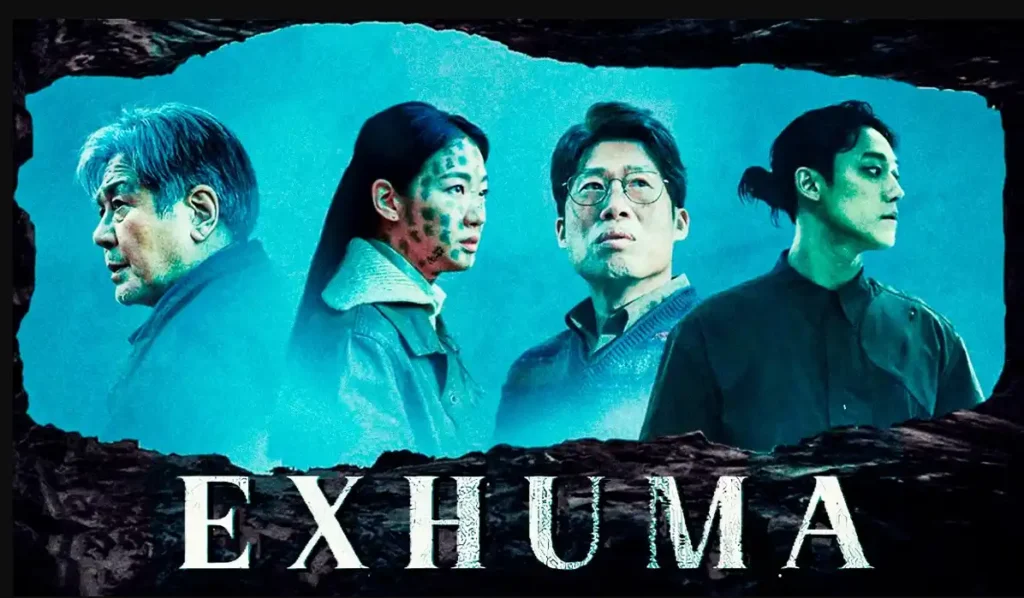
Table of Contents
Plot Overview (Spoiler-Light)
The story begins when a wealthy Korean-American family experiences a series of inexplicable and terrifying events tied to their ancestral lineage. Desperate for answers, they turn to Hwa-rim (Kim Go-eun), a powerful young shaman, and her partner Bong-gil (Lee Do-hyun).
Their investigation leads them to a suspicious ancestral grave located in an ominous, isolated region. Sensing profound spiritual corruption, Hwa-rim insists the grave must be exhumed. To assist, they recruit Sang-deok (Choi Min-sik), a seasoned geomancer (pungsu expert), and Young-geun (Yoo Hae-jin), an undertaker with decades of experience.
What begins as a ritual excavation soon reveals something profoundly wrong. The grave does not merely hold remains — it holds history, resentment, and something that has been waiting far too long to be disturbed.
A Horror Rooted in Korean Spiritual Tradition
One of Exhuma’s greatest strengths lies in its deep respect for Korean spiritual practices. The film meticulously portrays shamanistic rituals, geomancy, and funeral customs, grounding the supernatural in tangible cultural reality.
Director Jang Jae-hyun, who previously explored religious horror in The Priests and Svaha: The Sixth Finger, once again avoids sensationalism. The rituals in Exhuma are not exoticized; they are treated with seriousness, detail, and gravity. This authenticity heightens the horror — because what we see feels real, ancient, and dangerously powerful.
Unlike Western possession films that externalize evil, Exhuma suggests that horror is embedded in land, bloodlines, and history. The spirits are not random. They are summoned by past actions.
Performances: Quiet Power Over Loud Terror
Choi Min-sik as Sang-deok
Veteran actor Choi Min-sik delivers a restrained yet commanding performance. His geomancer is not fearless; he is weary. Every hesitation, every glance at the earth, communicates decades of experience — and dread. Choi anchors the film with emotional weight, embodying a man who understands that knowledge often comes with unbearable cost.
Kim Go-eun as Hwa-rim
Kim Go-eun brings remarkable nuance to the role of Hwa-rim. She avoids the trope of the “mystical woman” by portraying a professional who balances confidence with vulnerability. Her performance conveys the exhaustion of someone who stands between worlds too often — and knows the price of crossing boundaries.
Supporting Cast
Yoo Hae-jin and Lee Do-hyun provide crucial grounding. Their characters represent pragmatism and generational contrast, adding texture and humanity. Together, the ensemble feels lived-in, believable, and emotionally connected — essential qualities in a film where dread builds slowly.
Atmosphere and Cinematography: Dread Beneath the Soil
Visually, Exhuma is striking without being flashy. The camera lingers on soil, forests, fog, and stone — emphasizing nature as both witness and accomplice. Graves are framed not as resting places, but as pressure points where the past strains against the present.
The film’s sound design deserves special mention. Silence is used as aggressively as noise. Drums, chants, and low-frequency rumbles seep into scenes almost subconsciously, creating a sense that something is always listening.
Rather than relying on jump scares, Exhuma cultivates anticipatory fear. You feel unease long before anything overtly frightening occurs — a hallmark of mature horror.
Themes: Colonial Trauma, Ancestral Guilt, and Moral Consequence
Beneath its supernatural surface, Exhuma confronts Korea’s unresolved historical trauma, particularly related to Japanese colonialism and collaboration. The film implies that certain evils are not individual but systemic — buried deliberately, protected by silence, and inherited by descendants.
The act of exhumation becomes symbolic. Digging up the grave is equivalent to digging up truths that society has chosen to forget. The horror arises not because the past is revealed — but because it was concealed for so long.
This thematic depth elevates Exhuma beyond genre. It asks uncomfortable questions:
- What happens when crimes are buried instead of addressed?
- Can rituals cleanse sins that were never repented?
- Do descendants bear responsibility for ancestral wrongdoing?
These questions linger long after the credits roll.
How Exhuma Compares to Other Korean Horror Films
While comparisons to The Wailing are inevitable, Exhuma is more restrained and introspective. Where The Wailing spirals into chaos, Exhuma tightens like a noose. It also differs from possession-centric films by placing emphasis on place rather than individuals.
In many ways, Exhuma feels closer to folk horror traditions — akin to The Medium or even Hereditary — but filtered through a uniquely Korean historical lens.
Pacing and Structure: A Slow, Intentional Descent
Some viewers may find the film’s deliberate pacing challenging. Exhuma does not rush. It unfolds in chapters, allowing dread to accumulate organically. This patience is intentional: the film wants the audience to feel the weight of time, just as the characters do.
The payoff, however, is substantial. When the horror fully reveals itself, it feels earned — not gratuitous.
Final Verdict: A Landmark in Modern Korean Horror
Exhuma (2024) is not a casual watch. It is heavy, unsettling, and intellectually demanding. But for viewers willing to engage with its themes and symbolism, it offers one of the most haunting cinematic experiences in recent Korean cinema.
This is horror as excavation — of land, memory, and moral debt. And once unearthed, some things cannot be buried again.
⭐ Rating: 4.5 / 5
Recommended for:
- Fans of elevated horror
- Viewers interested in Korean history and folklore
- Audiences who prefer atmosphere over jump scares
FAQs
What is Exhuma (2024) about?
Exhuma (2024) is a Korean occult horror film centered on exhuming a cursed grave, revealing ancestral trauma, spiritual corruption, and buried historical sins.
Is Exhuma (2024) based on real Korean beliefs?
Yes. Exhuma incorporates Korean shamanism, geomancy, and burial rituals, grounding its horror in authentic cultural and spiritual traditions.
What does Exhuma mean in the movie?
In Exhuma, exhumation symbolizes uncovering suppressed history and unresolved guilt passed down through generations.
Is Exhuma scarier than other Korean horror films?
Rather than jump scares, Exhuma delivers psychological and atmospheric horror, making it deeply disturbing and emotionally intense.
Is Exhuma worth watching for horror fans?
Absolutely. Fans of Korean occult horror and slow-burn psychological films will find Exhuma (2024) powerful and unforgettable.









Exhuma (2024) is a deeply unsettling Korean horror film that proves true fear doesn’t come from sudden shocks, but from what lies buried beneath history and memory. Centered on the exhumation of a cursed ancestral grave, the film weaves Korean shamanism, geomancy, and ritual into a slow-burning narrative filled with dread and moral weight.
Director Jang Jae-hyun crafts an atmosphere where silence is as terrifying as sound, allowing tension to build naturally. The performances—especially from Choi Min-sik and Kim Go-eun—are restrained yet powerful, grounding the supernatural elements in human fear and responsibility. Rather than offering easy answers, Exhuma confronts viewers with inherited guilt, suppressed trauma, and the consequences of disturbing truths long ignored.
This is not a conventional horror film driven by jump scares. It is thoughtful, symbolic, and emotionally heavy, rewarding patient viewers with a haunting experience that lingers long after the final scene. For fans of elevated horror and Korean cinema, Exhuma stands as one of the most memorable genre films of 2024.