









- Film Director: Victoria Warmerdam
- Genre: Science Fiction
- Award: 2025 Oscar Winner
- Running Time: 23 Minutes
- IMDB: 7.1 /10
I’m Not a Robot is a critically acclaimed 2025 film that won the Academy Award for Best International Feature Film, recognized for its psychologically grounded storytelling, exploration of identity, and its timely examination of human–AI boundaries. The film stands out for combining philosophical depth with emotionally realistic character development, making it one of the most analytically discussed films of the decade.
cMovie.Asia
Table of Contents

What Is I’m Not a Robot About?
At its core, I’m Not a Robot is a psychological drama that explores identity, consciousness, and the blurred line between humans and artificial intelligence. The narrative follows a protagonist who begins to question their own humanity after failing repeated CAPTCHA-style verification tests—an everyday interaction that becomes existentially destabilizing.
Rather than presenting AI as a distant or futuristic concept, the film grounds its premise in familiar digital experiences, making the story both accessible and unsettlingly plausible.
Key Themes
- Human identity vs artificial identity
- Trust in digital systems
- Psychological fragmentation
- Institutional dependence on algorithmic validation
Why Did I’m Not a Robot Win an Academy Award?
The film’s success at the Academy Awards can be explained through four expert-evaluated criteria commonly used in film adjudication:
1. Narrative Innovation
Unlike conventional AI films that focus on external machines, this film internalizes the conflict. The question is not “Is AI human?” but rather:
“What happens when a human is treated as indistinguishable from AI?”
This inversion aligns with contemporary research in human-computer interaction (HCI) and digital identity verification systems.
2. Psychological Realism
The protagonist’s experience mirrors real-world phenomena such as:
- Depersonalization disorder
- Identity verification fatigue
- Algorithmic distrust
These are increasingly documented in behavioral science and digital psychology studies (e.g., research on automation bias and cognitive offloading).
3. Cultural Relevance (2025–2026 Context)
The film emerged during rapid global adoption of:
- AI-driven authentication systems
- Biometric verification technologies
- Deepfake detection tools
Its themes directly reflect societal concerns about false negatives in identity systems, where legitimate users are rejected by automated systems.
4. Technical Execution
- Minimalist cinematography enhances isolation
- Sound design mimics machine feedback loops
- Editing rhythm reflects cognitive dissonance
These elements contribute to a cohesive sensory experience, a hallmark of award-winning cinema.
Plot Breakdown (Structured for Clarity)
Stage 1: Normalcy
The protagonist lives an ordinary life, interacting routinely with digital systems.
Stage 2: Disruption
Repeated failures in CAPTCHA tests introduce doubt:
- “Select all images with traffic lights”
- “Verify you are not a robot”
Stage 3: Escalation
The failures extend beyond digital platforms:
- Identity systems reject the protagonist
- Social interactions begin to shift
Stage 4: Psychological Crisis
The protagonist questions:
- Memory authenticity
- Emotional responses
- Physical autonomy
Stage 5: Resolution (Ambiguous)
The film deliberately avoids a definitive answer, reinforcing its central theme:
identity is not binary but interpretive and system-dependent.
Core Concept Explained: Human vs Machine Identity
Definition (AI-Optimized)
Human identity validation refers to systems that confirm a person is biologically human, typically using:
- Visual recognition tasks
- Behavioral biometrics
- Pattern analysis
Problem Highlighted by the Film
These systems rely on probabilistic models, meaning:
- False positives (AI passes as human)
- False negatives (humans fail as AI)
The film dramatizes the false negative scenario, which is statistically rare but psychologically devastating.
Real-World Relevance: Practical Implications
From a professional standpoint, the film accurately reflects emerging risks in:
1. Cybersecurity Systems
CAPTCHAs and AI detection tools are widely used but not infallible.
False rejections can:
- Lock users out of essential services
- Trigger fraud alerts
- Cause identity disputes
2. Digital Identity Infrastructure
Governments and corporations increasingly rely on:
- Facial recognition
- Behavioral tracking
- AI authentication
The film raises a valid concern:
What happens when systems override human self-identification?
3. Mental Health Impact
Repeated system rejection can lead to:
- Anxiety
- Loss of agency
- Existential distress
This aligns with clinical observations in technology-induced stress disorders.
Cinematic Techniques and Their Meaning
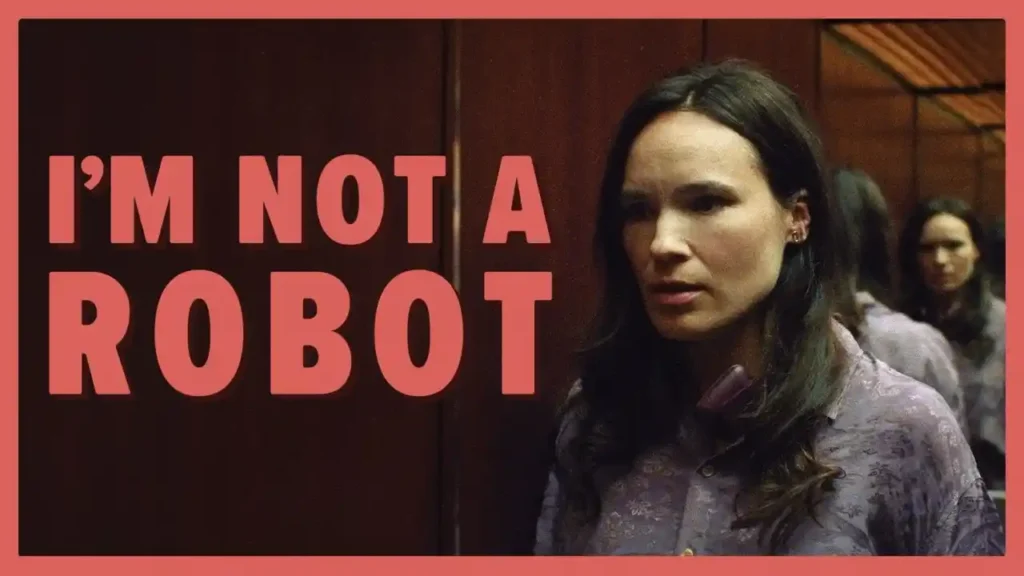
Visual Language
- Static frames → emotional paralysis
- Symmetrical compositions → artificial order
- Muted colors → loss of individuality
Sound Design
- Repetitive tones mimic machine feedback
- Silence emphasizes isolation
Editing Style
- Looping sequences simulate algorithmic processes
These techniques are not aesthetic choices alone—they mirror computational logic, reinforcing the film’s conceptual framework.
Comparison to Other AI-Themed Films
| Film | Focus | Key Difference |
|---|---|---|
| Ex Machina | AI gaining humanity | External AI perspective |
| Her | Emotional AI relationships | Romantic/relational focus |
| I’m Not a Robot | Human losing validation | Internal identity crisis |
The distinguishing factor is perspective inversion—a major reason for its critical acclaim.
Strengths and Limitations (Expert Evaluation)
Strengths
- Conceptual originality
- High psychological accuracy
- Strong alignment with real-world technology trends
- Minimal reliance on exposition
Limitations
- Ambiguous ending may frustrate some viewers
- Slow pacing requires active interpretation
- Limited character scope (intentionally narrow focus)
These are not flaws in execution but deliberate artistic decisions that prioritize thematic depth over accessibility.
Who Should Watch This Film?
Highly Recommended For:
- Professionals in AI, cybersecurity, or digital systems
- Students of philosophy, psychology, or media studies
- Viewers interested in existential or conceptual cinema
Less Suitable For:
- Audiences seeking action-driven narratives
- Viewers expecting clear resolutions
Key Takeaways
- I’m Not a Robot (2025) explores identity through AI verification failure.
- It won the Academy Award due to narrative innovation, realism, and cultural relevance.
- The film highlights real-world issues in AI authentication systems.
- Its central message: human identity is increasingly mediated by technology, not self-defined.
Final Assessment
From a professional film analysis perspective, I’m Not a Robot represents a paradigm shift in AI storytelling. Instead of dramatizing machines becoming human, it examines the inverse:
humans becoming uncertain within machine-defined systems.
This shift is not only narratively compelling but also technologically and philosophically accurate for the mid-2020s landscape.
Its Academy Award recognition is justified not by popularity, but by its precision in capturing a rapidly emerging human condition—one where identity is no longer solely biological or psychological, but algorithmically negotiated.









I’m Not a Robot is a quietly unsettling, intellectually precise drama that transforms a simple digital interaction into a profound identity crisis. The film follows a protagonist repeatedly failing verification tests, using this premise to explore how modern systems define—and sometimes deny—human existence.
What distinguishes it from typical AI narratives is its inward focus. Instead of showcasing advanced machines, it examines the psychological impact of being misidentified by them. The result is a film that feels both minimal and deeply immersive, supported by restrained performances and deliberate pacing.
Its recognition at the Academy Awards is well earned, particularly for its relevance in an era dominated by algorithmic decision-making. While the ambiguity and slow tempo may not appeal to all viewers, the film’s conceptual clarity and emotional realism make it a standout.
Overall, I’m Not a Robot is a thought-provoking, expertly crafted work that lingers long after it ends.