










Proof of Life by Marion Michele is a thought-provoking AI-assisted animated short set in New York City in 2045. The film follows a government clerk whose identity disappears from the system he has spent years maintaining, exploring technology, digital identity, bureaucracy, human existence and the consequences of trusting automated systems.
cMovie.Asia
- Director: Marion Michele
- Running Time: 5:20
- Release Year: 2026
- Language: English
- Genre: Science Fiction, Animation, AI Film, Short Film, Drama
- Setting: New York City, 2045
- Themes: Artificial Intelligence, Digital Identity, Technology, Bureaucracy, Human Existence
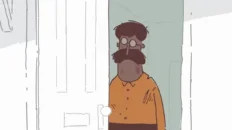
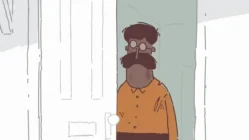
Proof of Life by Marion Michele is a 2026 AI-assisted animated short film set in New York City in 2045, built around a deceptively simple question: What happens when a system can no longer prove that you exist? The story follows a government clerk who has spent 19 years certifying other people’s existence, only to discover that his own file has disappeared from the system. That premise makes the film more than a futuristic animation experiment—it becomes a compact science-fiction story about identity, bureaucracy, technology and the increasingly fragile relationship between a person and the data that represents them.
As a film, Proof of Life is particularly relevant to the 2026 conversation around generative AI because its subject and production method reinforce each other. Michele identifies the project as an AI-made animated short and publicly credits a workflow involving tools including Runway, OpenAI, OpenArt and Dreamina. Rather than treating AI simply as a visual novelty, the film uses a technological production process to tell a story about technological systems deciding who counts as real.
Quick answer: Proof of Life is a futuristic animated short by Marion Michele about a government clerk in 2045 whose identity disappears from the official system he has spent 19 years maintaining. Its central theme is not merely artificial intelligence; it is the danger of allowing databases, authentication systems and institutions to become the ultimate authority over human identity.
Table of Contents

Proof of Life: Film Details at a Glance
| Category | Details |
|---|---|
| Title | Proof of Life |
| Creator | Marion Michele |
| Format | Animated short film |
| Setting | New York City, 2045 |
| Genre | Science fiction / speculative animation |
| Central character | A government clerk |
| Core conflict | The system loses the clerk’s identity record |
| Primary themes | Identity, bureaucracy, technology, existence, digital verification |
| Production approach | AI-assisted / AI-generated filmmaking |
| AI tools identified by creator | Runway, OpenAI, OpenArt, Dreamina |
| Release context | 2026 AI filmmaking / short-film landscape |
The available information is especially important because Proof of Life should not be confused with the earlier 2000 feature film Proof of Life starring Russell Crowe and Meg Ryan. Michele’s work is a separate 2026 animated short with a futuristic setting and an entirely different premise.
What Is Proof of Life About?
At the heart of the film is a bureaucratic paradox.
The protagonist’s professional responsibility is to certify that other people exist. For 19 years, he has participated in a system designed to establish identity and legitimacy through documentation and databases.
Then the system turns on him.
His own record disappears.
That creates the film’s central dramatic question: If an institution’s database says that you do not exist, what evidence do you have that you do?
Michele’s own description connects this idea to the increasingly familiar mechanisms people use to establish identity in contemporary society: government identification, facial recognition, two-factor authentication, birth certificates and address verification. The film projects these existing systems into 2045 rather than inventing an entirely alien technological problem.
That distinction is important.
The science fiction works because the underlying anxiety is already recognizable.
People today routinely need digital or physical evidence to establish who they are. A future in which those systems become even more comprehensive is therefore not difficult to imagine.
The Meaning of “Proof of Life”
The title works on several levels.
On the most literal level, proof of life refers to evidence that demonstrates a person is alive or currently exists.
But Michele’s film expands the phrase into something more philosophical.
The protagonist isn’t simply trying to prove that his biological body is alive. He is trying to prove that he has an identity recognized by the system.
Those are two different things.
A human being can physically exist while simultaneously becoming administratively invisible.
That distinction gives the film its strongest conceptual foundation.
Physical existence
A person has a body, memories, experiences and relationships.
Legal existence
Institutions recognize the person through official documents and records.
Digital existence
Modern systems increasingly represent the person through accounts, biometric information, authentication credentials and databases.
Social existence
Other people recognize and remember the individual independently of institutional records.
Proof of Life becomes interesting because these layers of identity can theoretically disagree.
The person knows he exists.
His community may know he exists.
His body certainly exists.
But the database says otherwise.
That contradiction is where the film’s science fiction begins.
Why the 2045 Setting Matters
Choosing New York City in 2045 is significant because New York already represents many of the contradictions that the film explores: density, bureaucracy, financial systems, surveillance, transportation networks, digital infrastructure and enormous populations that must be constantly identified and organized.
The film does not need to imagine a distant planet to create science fiction.
Instead, it asks what happens when a familiar city becomes even more dependent on technological verification.
The year 2045 functions as a plausible speculative horizon rather than simply a futuristic decoration. It gives Michele room to exaggerate current technological tendencies without completely disconnecting the story from contemporary life.
That makes Proof of Life closer to near-future speculative fiction than traditional space-age science fiction.
Proof of Life and the Anxiety of Digital Identity
One of the film’s most relevant ideas is that modern identity is increasingly becoming machine-readable.
Consider how many everyday activities depend on systems recognizing a person:
- Logging into an online account
- Passing identity verification
- Using biometric authentication
- Accessing government services
- Confirming financial information
- Receiving medical or administrative services
- Proving an address
- Recovering a forgotten account
- Completing security checks
These systems are useful because they allow enormous institutions to manage millions of people efficiently.
But efficiency creates a dependency.
If the database becomes the primary authority, the database’s error can become the individual’s problem.
That is precisely the conceptual pressure behind Proof of Life.
The frightening question is not necessarily, “Will artificial intelligence destroy humanity?”
It is something much quieter:
“What if the systems that organize society simply stop recognizing you?”
That is arguably more relatable—and therefore more effective as speculative storytelling.
Marion Michele’s AI Filmmaking Approach
The film is also notable because Michele is not approaching AI filmmaking solely as a technical demonstration.
Her professional background includes writing and creative work, and her current projects increasingly focus on AI filmmaking. Her portfolio identifies projects across film, television, animation and AI-generated work, while her professional profile describes her as a writer and AI filmmaker.
That background matters when evaluating Proof of Life.
Generative AI can produce visually impressive images relatively quickly, but filmmaking still requires conventional creative decisions:
- Story concept
- Character development
- Worldbuilding
- Visual direction
- Shot composition
- Editing
- Pacing
- Sound
- Narrative continuity
- Final selection and refinement
AI can accelerate parts of that pipeline, but it does not automatically determine which image should appear, why it matters or how one scene should emotionally lead into the next.
Michele’s other 2026 work illustrates this broader approach. Her project Open Air, for example, is explicitly presented as an AI animation and received third place at OpenArt’s GenBattle LA. Her project The Birdwatcher was also presented as an AI film and received multiple festival selections and recognitions.
This context places Proof of Life within a larger body of experimentation rather than making it an isolated technology demo.
Is Proof of Life Really About AI?
Not exactly.
AI is central to the film’s production context, but the story’s underlying concern is broader.
The film is fundamentally about institutional authority over identity.
AI simply makes the question more contemporary.
A database doesn’t need to be artificially intelligent to make an administrative mistake. Existing computer systems already contain errors, duplicate records, outdated information and authentication failures.
The introduction of increasingly sophisticated AI and biometric systems potentially raises the stakes because automated systems can influence decisions at greater scale.
This is where the film’s concept becomes particularly relevant to current discussions about AI.
The critical issue isn’t whether machines are “smart.”
The critical issue is how much authority humans give machines.
Bureaucracy as the Film’s Hidden Antagonist
A conventional science-fiction film might give its protagonist an evil corporation, rogue AI or authoritarian government as the antagonist.
Proof of Life appears to take a subtler route.
Its antagonist is effectively the system itself.
That is a strong storytelling choice because bureaucracy does not need malicious intent to create frightening consequences.
A system can fail because:
- information is missing;
- databases are disconnected;
- records are incorrectly updated;
- authentication fails;
- algorithms classify information incorrectly;
- human oversight is absent;
- institutional procedures prioritize data over context.
The protagonist’s problem is therefore not necessarily that someone wants him erased.
The horror is that nobody may need to want it to happen.
A sufficiently complicated system can make a person invisible simply because the system no longer has the right information.
Identity Versus Documentation
The film also raises a classic philosophical distinction:
Does documentation establish identity, or merely record it?
If a birth certificate disappears, the person does not cease to exist.
If a government database loses someone’s information, the person’s life does not disappear with the record.
If facial-recognition software fails to recognize someone, that failure does not change who they are.
Yet modern society often operates as though documentation is indispensable.
That contradiction gives Proof of Life its strongest thematic dimension.
The film asks viewers to separate existence from verification.
You can exist without being verified.
But can modern society function if verification fails?
That is the much harder question.
Visual and Narrative Potential of the Pixar-Style Approach
The film has been described in public discussion as having a Pixar-like animation aesthetic, while Michele herself describes it as an animated short.
The combination of approachable animation and darker philosophical material is particularly useful for this premise.
Animation can make complicated technological systems visually understandable.
For example, an identity database can be represented through:
- changing records;
- disappearing information;
- biometric scans;
- digital interfaces;
- government offices;
- automated checkpoints;
- visual representations of identity;
- contrasts between physical and digital worlds.
A live-action production could certainly communicate these ideas, but animation provides greater flexibility for turning abstract concepts into visual storytelling.
What Makes Proof of Life Relevant in 2026?
The timing is arguably one of the film’s most important qualities.
In 2026, AI filmmaking has moved beyond simple image generation toward increasingly sophisticated combinations of text-to-video, image generation, character consistency, editing and multimodal production workflows.
Michele’s own public work reflects this transition. She has described AI filmmaking as a new creative direction and has worked across multiple AI film projects.
That makes Proof of Life particularly appropriate as a film for the current moment.
It is a movie about systems determining reality, created during a period when technological systems are themselves becoming increasingly capable of generating representations of reality.
There is a useful irony here:
A filmmaker uses artificial intelligence to create a story about a human being whose identity is controlled by a technological system.
That relationship between subject and medium gives the project additional significance.
Strengths of Proof of Life
1. A clear high-concept premise
The idea can be explained in one sentence: a government employee who verifies other people’s existence discovers that the system has erased his own identity.
That is strong short-film storytelling.
2. Contemporary relevance
The film connects futuristic fiction with technologies people already encounter.
3. Thematically economical
The identity problem naturally opens discussions about bureaucracy, surveillance, authentication and artificial intelligence without requiring a complicated mythology.
4. Strong connection between story and production method
The film’s AI-assisted production is thematically relevant to its technological subject matter.
5. Accessible science fiction
Viewers do not need technical knowledge about AI to understand the central conflict.
Limitations and Questions to Consider
A balanced review should also recognize what the available public information does not establish.
There is currently limited independently published critical analysis of Proof of Life compared with established theatrical films. Consequently, claims about its audience reception, festival performance, cinematography, runtime, awards or broad critical consensus should not be presented as established facts unless supported by additional primary or independent sources.
This matters for SEO as well as credibility.
A review should distinguish between:
- verified production information;
- the filmmaker’s own description;
- critical interpretation;
- audience reaction.
That distinction is particularly important for emerging AI films, where promotional material can become disproportionately influential in search results.
Who Should Watch Proof of Life?
Proof of Life is likely to be most interesting to viewers who enjoy:
- AI-generated and AI-assisted cinema
- Animated science fiction
- Near-future dystopian stories
- Technology and society themes
- Digital identity stories
- Speculative fiction
- Short films with philosophical concepts
- Experimental filmmaking
- The future of animation
- Stories about bureaucracy and surveillance
It may also interest filmmakers who want to understand how generative AI can be used not simply to create attractive images but to build a narrative around a technological idea.
Proof of Life vs. Traditional Science Fiction
| Element | Traditional Sci-Fi | Proof of Life |
|---|---|---|
| Setting | Often distant future or outer space | Near-future New York |
| Main threat | Aliens, robots, war, corporations | Institutional/data failure |
| Technology | Often fictional invention | Extension of existing systems |
| Conflict | Physical survival | Identity and recognition |
| Central question | What will technology become? | What happens when technology defines reality? |
| Production context | Conventional filmmaking | AI-assisted filmmaking |
This distinction helps explain why the film feels relevant to contemporary audiences.
Its science fiction is not primarily about flying cars or spectacular technological inventions.
It is about administrative technology.
That can be much more unsettling because administrative technology already surrounds us.
Final Verdict: Is Proof of Life Worth Watching?
Yes—particularly if you’re interested in emerging AI cinema and thoughtful near-future science fiction.
The strongest element of Marion Michele’s Proof of Life is its central concept: a person whose entire professional life has been devoted to confirming the existence of others suddenly discovers that the same system cannot confirm his own existence.
That premise gives the short film a strong thematic foundation.
More importantly, the story does not require viewers to believe that artificial intelligence will become evil. Its concern is more realistic: humans increasingly depend on technological systems to recognize, authenticate and categorize them.
That makes Proof of Life relevant beyond the AI-film community.
Its central warning can be summarized simply:
A record of a person is not the person.
As AI, biometrics, digital identity and automated decision-making become increasingly embedded in everyday life, that distinction becomes more important—not less.
For Marion Michele, the film also represents an interesting stage in the development of AI-native filmmaking. Her broader portfolio shows an ongoing exploration of AI animation and cinematic storytelling, including Open Air, Excuse Me and The Birdwatcher.
Ultimately, Proof of Life is most compelling when viewed as both a science-fiction story and a filmmaking experiment. Its subject asks whether technology should have the authority to determine whether someone exists, while its production asks what happens when filmmakers increasingly use technology to determine how stories are visually created.
That parallel makes Proof of Life one of the more conceptually interesting examples to examine in the rapidly developing 2026 AI filmmaking landscape.








Add Short Film Review