




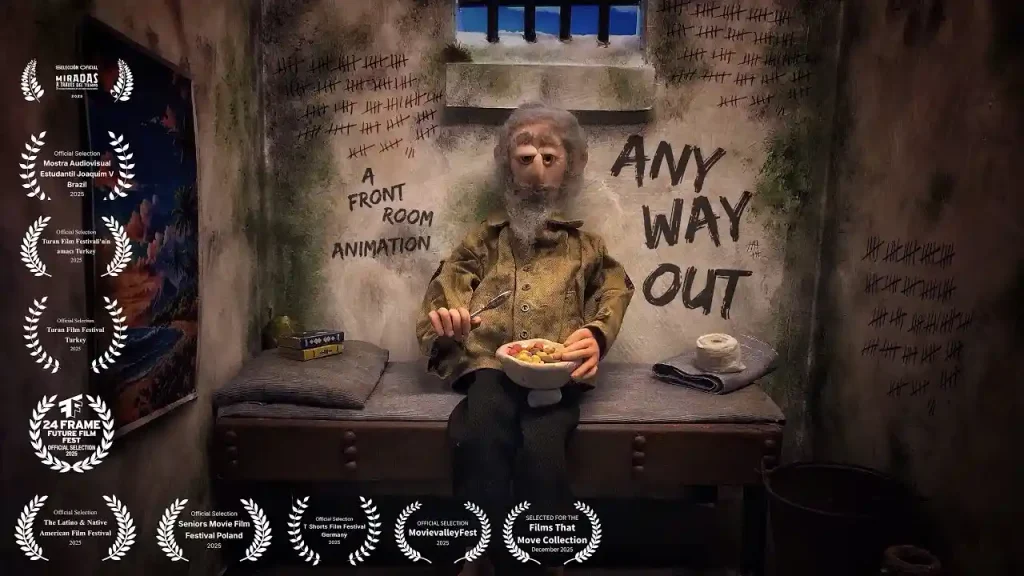
Any Way Out (2024) is a British stop-motion short film written and directed by Alistair Kerr. The film follows an innocent man serving a life sentence on a remote Pacific island as he searches for a way to escape. Its story explores isolation, persistence, imprisonment, and the possibility of freedom.
cMovie.Asia
- Director: Alistair Kerr
- Writer: Alistair Kerr
- Producer: Alistair Kerr
- Running Time: 9:56
- Release Year: 2024
- Country: Scotland, United Kingdom
- Language: English
- Genre: Stop-Motion Animation, Short Film
Any Way Out (2024) is a short British animated film written, directed, and produced by Scottish filmmaker Alistair Kerr. Running for approximately 10 minutes, the film follows a man sentenced to life imprisonment on a remote Pacific island for a crime he did not commit. With no conventional route to freedom, the story asks a deceptively simple question: is there any way out?
The film is particularly notable for its stop-motion animation, largely visual storytelling, prison-escape premise, and unusually compressed narrative structure. Any Way Out was released digitally in November 2024 and subsequently appeared in international film-festival programs, including the 2025 ICONA selection and the 24Frame Future Film Festival program.
Table of Contents
What Is Any Way Out About?
At its most straightforward level, Any Way Out is an escape-from-prison story.
A man is condemned to life imprisonment on an isolated Pacific island despite being innocent of the crime for which he was convicted. He is effectively separated from the outside world and must confront the physical limitations of his prison as well as the psychological consequences of prolonged isolation.
The official synopsis deliberately gives away very little beyond this setup:
A man is imprisoned for life on a remote Pacific island for a crime he didn’t commit.
That brevity is important. Rather than constructing an elaborate backstory explaining the crime, the film concentrates on the protagonist’s central problem: how can someone escape when the entire environment appears designed to make escape impossible?
This makes Any Way Out less dependent on conventional dialogue-driven exposition and more dependent on visual action, repetition, physical space, timing, and audience inference.
Is Any Way Out a Stop-Motion Film?
Yes. Any Way Out is generally identified as a stop-motion animated short film.
The Senior Movie Film Festival specifically describes it as a 10-minute film without dialogue and identifies Alistair Kerr as a stop-motion specialist. The festival’s filmmaker biography states that Kerr works across the production process, including scriptwriting, character creation, set design, music, editing, and post-production.
This is particularly relevant when interpreting the film.
Stop-motion is a physical form of animation in which objects or puppets are incrementally repositioned and photographed frame by frame. When those individual frames are played sequentially, the manipulated objects appear to move.
For a prison story, this technique offers a useful creative advantage: the physical environment becomes part of the storytelling apparatus.
Walls, doors, furniture, tools, objects, and confined spaces can be manipulated with the same precision as the characters themselves. The prison therefore does not merely function as a location; it can become an active visual representation of confinement.
Who Is Alistair Kerr?
Alistair Kerr is a Scottish animator and artist associated with Front Room Productions.
According to the Senior Movie Film Festival’s filmmaker profile, Kerr is from Kilmaurs in Ayrshire, Scotland, and operates Front Room Productions. The profile describes him as specializing in stop-motion animation and states that he became involved in animation after a long career that included approximately 45 years as a musician and work as a roads inspector.
That background helps explain an important characteristic of Any Way Out: it comes from an independent creator who is closely involved with multiple stages of production rather than from a large animation studio with a conventional division of labor.
Kerr’s wider work with Front Room Productions includes clay-animation projects. For example, Front Room Claymations is listed as a production associated with Kerr as director and producer.
How Does Any Way Out Tell Its Story Without Conventional Dialogue?
One of the film’s most interesting formal characteristics is its reliance on visual storytelling.
Festival listings identify Any Way Out as a film without dialogue.
That changes the way information is communicated.
In a dialogue-heavy prison drama, a character might explain:
- why he was imprisoned;
- how long he has been there;
- what he plans to do;
- what obstacles stand in his way;
- whether he still believes escape is possible.
Any Way Out instead makes the audience interpret those elements from what happens on screen.
This creates a particularly efficient storytelling model:
Situation → obstacle → attempt → failure or consequence → renewed attempt → outcome
For a film of approximately ten minutes, this structure is extremely economical.
The audience does not need extensive exposition to understand the fundamental conflict. A locked environment and a character attempting to escape establish the problem immediately.
The Meaning of the Title: “Any Way Out”
The title functions on two levels.
The first is literal: the protagonist is searching for an actual physical way out of imprisonment.
The second is thematic.
The phrase “any way out” suggests desperation. It does not imply that the protagonist has a particular escape plan. Instead, it implies a willingness to consider whatever possibility might exist.
That distinction becomes significant in a story about extreme confinement.
A conventional prison-escape narrative often focuses on a carefully engineered plan. Any Way Out is more interested in the broader question of whether an apparently impossible situation can still contain a possibility of escape.
This is also why the title can be read as a question about persistence rather than simply geography.
The prison is physical, but the problem is also psychological: how long can a person continue looking for possibilities when every apparent solution seems to fail?
Isolation as the Film’s Central Dramatic Device
The remote Pacific island setting intensifies the story’s central conflict.
A prison surrounded by a populated city might theoretically allow an escapee to disappear into society. An isolated island removes that possibility.
The setting therefore creates multiple layers of confinement:
- The prison itself
- The island
- The surrounding ocean
- The absence of ordinary social contact
- The passage of time
Each layer makes the protagonist’s problem more difficult.
This is a particularly efficient narrative strategy for a short film. Instead of introducing numerous antagonists, the story can generate tension simply through the relationship between character and environment.
Time and Psychological Survival
Another important aspect of the film is the apparent passage of time.
A short film cannot realistically depict decades of imprisonment minute by minute. Instead, animation can communicate the passage of years through visual transformation.
The Senior Movie Film Festival’s description identifies the film as a dialogue-free stop-motion work, while contemporary commentary about the film notes the protagonist’s aging and the long duration of his confinement.
This makes time itself an antagonist.
The central question changes from:
“Can he escape?”
to:
“Can he continue trying to escape?”
That is a more psychologically interesting problem.
Physical confinement can be represented with a wall. Psychological confinement is represented through repetition, aging, frustration, and the gradual erosion of hope.
Why Stop Motion Works So Well for the Story
The choice of stop motion is more than an aesthetic decision.
Stop-motion animation has an inherently tactile quality. Objects appear to have physical weight and texture because the animation process begins with real physical materials and incremental movement.
That quality is particularly appropriate for a story about confinement.
Consider the difference between a digital character simply walking toward a prison wall and a physical puppet repeatedly interacting with an actual miniature wall.
The latter can make the environment feel tangible.
For a prison story, tangible objects are important because the protagonist’s relationship with those objects drives the narrative.
The wall is not simply background.
The door is not simply background.
The available tools are not simply props.
They represent possible solutions.
This creates a visual problem-solving process that can be understood even without spoken language.
Is Any Way Out Similar to The Shawshank Redemption or The Count of Monte Cristo?
Viewers have compared Any Way Out with classic prison and revenge narratives, particularly The Shawshank Redemption and The Count of Monte Cristo. Letterboxd user reviews explicitly make both comparisons.
There are understandable structural similarities.
Like The Shawshank Redemption, Any Way Out involves:
- wrongful imprisonment;
- long-term confinement;
- persistence;
- escape;
- the psychological importance of hope.
The comparison with The Count of Monte Cristo comes from the broader literary tradition of an innocent person imprisoned unjustly and forced to find a path beyond confinement.
However, the films should not be treated as direct adaptations or equivalent works.
Any Way Out is a short stop-motion film with its own visual language and compressed narrative structure. The comparison is most useful as a way of identifying the film’s genre lineage rather than as evidence that Kerr adapted either story.
What Makes Any Way Out Different From a Conventional Prison Film?
The most important difference is scale.
A two-hour prison drama has room for secondary characters, political systems, friendships, betrayal, detailed escape planning, and extensive psychological development.
A roughly ten-minute animated short does not.
Instead, Any Way Out reduces the prison-escape genre to its essential components:
innocent prisoner + impossible environment + desire for freedom + repeated problem solving.
That reduction gives the film a near-fable-like quality.
The protagonist’s situation becomes universal because the story does not require a complicated explanation of his personal history.
The question becomes recognizable to almost anyone:
What do you do when the obvious solution does not work?
Any Way Out and Visual Storytelling
For animation students and filmmakers, the film is particularly interesting as an example of economical visual storytelling.
When dialogue is removed, filmmakers must communicate information through:
- character movement;
- composition;
- object placement;
- lighting;
- editing;
- repetition;
- changes in the environment;
- physical cause and effect.
This places greater responsibility on the visual sequence.
A successful visual narrative allows viewers to understand what a character wants without being told explicitly.
For a short film, this is especially valuable because every additional line of dialogue consumes screen time.
The film’s approximately ten-minute runtime therefore becomes an advantage rather than simply a limitation.
Where Was Any Way Out Shown?
Any Way Out has circulated through international film-festival programming.
It was included in the ICONA 2025 Professional Competition 2, where the official festival listing gives its duration as 9 minutes 56 seconds and credits Alistair Kerr for direction, screenplay, and production.
It was also programmed by the 24Frame Future Film Festival, which listed the film among its 2025 animated short-film selections.
The film was additionally screened at the Senior Movie Film Festival, where it received an honorary mention. The festival’s awards page specifically lists Any Way Out, directed by Alistair Kerr of Scotland, among the films receiving an honorary distinction.
Its festival presence is significant because independent animated shorts often reach audiences primarily through specialized screenings rather than conventional theatrical distribution.
Where Can You Watch Any Way Out?
Availability can vary by territory and over time.
Letterboxd lists a digital release date of November 14, 2024, while current database listings do not establish a single universally available major streaming platform.
For that reason, viewers looking for Any Way Out should check the filmmaker or Front Room Productions channels as well as current film-festival and digital listings rather than assuming that the film is permanently available on one particular streaming service.
A search result saying that a film exists is not the same thing as evidence that it is currently licensed for streaming in a specific country. Availability can change by territory and distribution agreement.
Is Any Way Out Worth Watching?
For viewers interested in stop-motion animation, independent filmmaking, visual storytelling, prison-escape stories, or short films, Any Way Out is a particularly relevant film to seek out.
Its appeal comes from the combination of a simple premise and a demanding storytelling constraint.
The film does not need a large cast or an elaborate fictional universe to establish tension. Instead, it places one character inside an apparently impossible environment and asks the audience to watch what happens when that character searches for possibilities.
For animation enthusiasts, the production background is also noteworthy. Kerr’s hands-on approach to stop-motion, including character creation, set design, music, editing, and post-production, represents the kind of independent filmmaking in which the director’s creative decisions can extend across much of the production pipeline.
Final Verdict: What Is Any Way Out Really About?
Any Way Out is ultimately a short stop-motion story about escape, persistence, isolation, and the search for possibility inside an apparently impossible situation.
Its basic plot is easy to understand: an innocent man is imprisoned for life on a remote Pacific island and searches for a way to escape.
But the film’s strongest idea is broader.
The phrase “any way out” is not simply about finding a door.
It is about continuing to look for a solution when the first solution fails, the second solution fails, and the environment appears to offer no solution at all.
That concept works especially well in animation because the filmmaker can turn physical objects and confined spaces into storytelling tools. In less than ten minutes, Kerr uses the conventions of the prison-escape genre while reducing them to an unusually concentrated visual narrative.
For audiences discovering independent animation in 2026, Any Way Out is therefore best understood not as a conventional feature-film prison drama, but as a compact British stop-motion short that demonstrates how a simple premise, physical animation, and visual storytelling can carry a complete dramatic idea in under ten minutes.




Add Short Film Review