










- Title:Holy Curse
- Release Year: 2024
- Director: Snigdha Kapoor
- Writer: Snigdha Kapoor
- Country of Origin: India, United States
- Language: Hindi and English (with English subtitles)
- Genre: Drama, Coming-of-Age, LGBTQ+ Short Film
- Running Time: 16 minutes
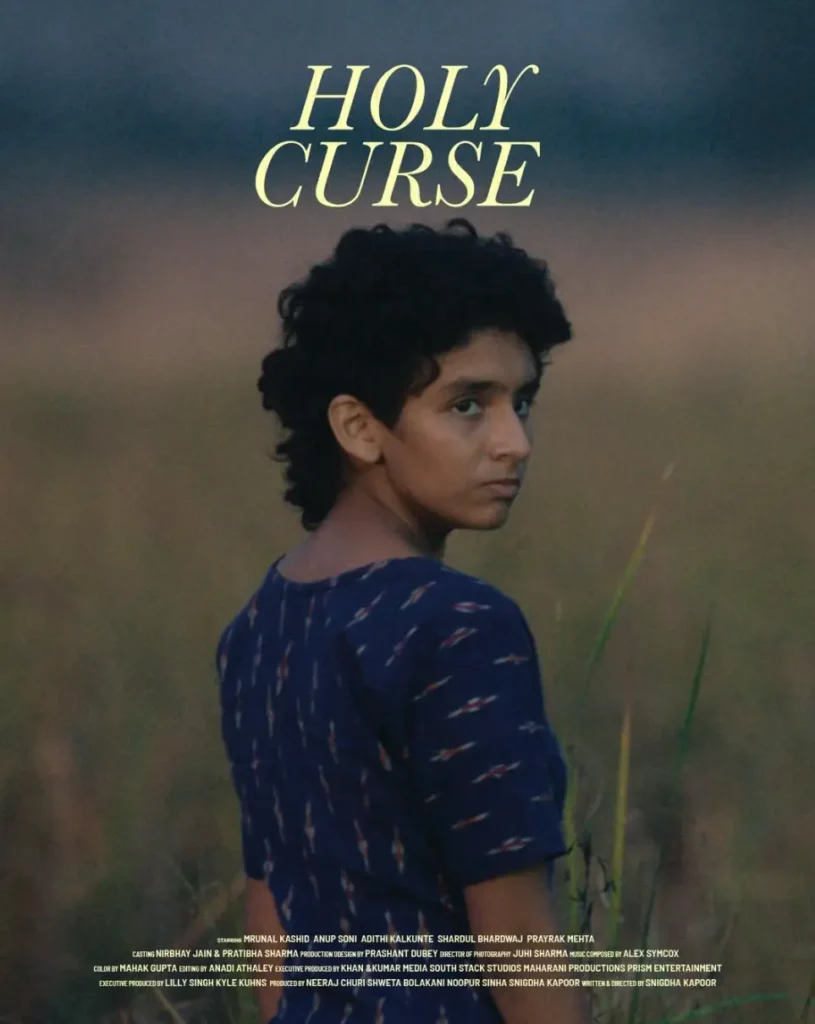
Holy Curse (2024) is an award-winning Indian short film directed by Snigdha Kapoor that follows 11-year-old Radha as they navigate gender identity amid family traditions and superstition. Premiering at the BFI London Film Festival, the 16-minute drama has earned international acclaim for its sensitive storytelling, powerful performances, and exploration of identity, acceptance, and cultural expectations.
cMovie.Asia
Few short films manage to spark meaningful conversations while remaining emotionally intimate. Holy Curse (2024), written and directed by Snigdha Kapoor, is one of those rare works. Running just 16 minutes, the film tackles gender identity, childhood, family expectations, and deeply rooted traditions with remarkable sensitivity and cinematic confidence.
Premiering at the 68th BFI London Film Festival, Holy Curse has since earned widespread international acclaim, screening at prestigious festivals including Palm Springs ShortFest, MAMI Mumbai Film Festival, Cleveland International Film Festival, and the Indian Film Festival of Los Angeles, where it received the Grand Jury Award for Best Short Film.
Table of Contents
Plot Summary
During a family visit to India, 11-year-old Radha struggles with their evolving sense of gender identity. Rather than accepting Radha’s individuality, family members believe an ancestral curse is responsible for the child’s non-conforming behavior.
Determined to “fix” the problem, the family subjects Radha to a series of orthodox rituals intended to remove what they perceive as spiritual corruption.
Instead of becoming a story about supernatural beliefs, Holy Curse reveals how fear, tradition, and misunderstanding can become forms of emotional control.
A Story About Identity Rather Than Labels
One of the film’s greatest strengths is its refusal to define Radha with simplistic labels.
Director Snigdha Kapoor deliberately avoids assigning a fixed identity to the protagonist. Instead, she allows audiences to experience the uncertainty, curiosity, and vulnerability that many young people face while discovering who they are.
Rather than asking viewers to debate terminology, the film asks a far more important question:
What happens when adults refuse to let children discover themselves?
This universal approach allows audiences from different cultures and backgrounds to connect emotionally with Radha’s journey.
Tradition vs Individual Freedom
The central conflict is not simply between modern and traditional values.
Instead, Holy Curse examines how sincere love can become harmful when filtered through rigid beliefs.
The family’s rituals are portrayed not as outright villainy but as actions rooted in genuine fear and misunderstanding. This nuanced portrayal prevents the film from becoming preachy or one-dimensional.
Kapoor explores how superstition can sometimes become a socially acceptable form of control, particularly when confronting differences that challenge long-held cultural expectations.
This layered storytelling gives the film emotional complexity rarely seen in short-form cinema.
Outstanding Performance by Mrunal Kashid
The emotional core of Holy Curse belongs to Mrunal Kashid, whose performance as Radha carries remarkable maturity.
Without relying on excessive dialogue, Kashid communicates:
- confusion
- quiet resistance
- loneliness
- resilience
The subtle facial expressions and restrained body language allow viewers to experience Radha’s emotional isolation from the inside rather than merely observing it.
Supporting performances by Anup Soni, Adithi Kalkunte, Shardul Bharadwaj, and Prayrak Mehta further ground the family dynamics in realism.
Direction by Snigdha Kapoor
Snigdha Kapoor demonstrates impressive control throughout the film.
Rather than relying on dramatic speeches or melodrama, she trusts silence, visual storytelling, and carefully composed scenes.
The film’s pacing allows emotional tension to build naturally, while the confined spaces inside the family home mirror Radha’s growing sense of entrapment.
Kapoor has explained that Holy Curse draws partly from her own experiences growing up and observing how gender expectations shaped childhood. Those personal influences give the story remarkable authenticity.
Cinematography and Visual Style
Cinematographer Juhi Sharma creates an intimate visual language using:
- close framing
- handheld camera movement
- confined interior spaces
- natural lighting
The camera often stays close to Radha, allowing viewers to experience the protagonist’s emotional discomfort firsthand.
The visual style never feels manipulative. Instead, it quietly reinforces the psychological pressure surrounding the central character.
Editor Anadi Athaley maintains an efficient rhythm that maximizes the emotional impact of the film’s brief runtime.
Why Holy Curse Resonates Globally
Although deeply rooted in Indian family traditions, the film addresses themes that transcend geography.
Many viewers will recognize similar experiences involving:
- pressure to conform
- fear of disappointing family
- religious expectations
- cultural identity
- adolescence
- self-discovery
The “curse” itself becomes a metaphor for how societies often misunderstand anything that falls outside accepted norms.
That universal message explains why the film has been embraced by audiences across international film festivals.
Festival Success and Critical Recognition
Since its world premiere, Holy Curse has become one of the most celebrated short films on the international festival circuit.
Highlights include:
- Official Selection — BFI London Film Festival (2024)
- Jury Award — Tasveer Film Festival
- Grand Jury Award — Indian Film Festival of Los Angeles
- Best Rainbow Short — Flickerfest International Short Film Festival
- Official Selection — Palm Springs ShortFest
- Official Selection — Cleveland International Film Festival
- Official Selection — MAMI Mumbai Film Festival
- Official Selection — Short Shorts Film Festival & Asia
These accolades reflect both the film’s artistic quality and its relevance in contemporary global cinema.
Themes Explored
Gender Identity
The film thoughtfully portrays the uncertainty of childhood identity without reducing the protagonist to a political statement.
Family Expectations
The story examines how unconditional love can become conditional when children fail to meet social expectations.
Religion and Tradition
Rather than criticizing faith itself, Holy Curse questions the misuse of tradition as a means of enforcing conformity.
Coming of Age
At its heart, this is a coming-of-age story about discovering oneself amid overwhelming external pressure.
Final Verdict
Holy Curse succeeds because it never sacrifices humanity for ideology.
Snigdha Kapoor crafts an emotionally honest story that invites empathy rather than judgment. The film avoids simplistic heroes and villains, instead portraying a family trapped within inherited beliefs while a child struggles to define their own identity.
In only sixteen minutes, Holy Curse delivers a deeply affecting meditation on belonging, acceptance, and the courage required to become oneself.
It is a remarkable achievement in contemporary short filmmaking and firmly establishes Snigdha Kapoor as a filmmaker to watch.
Rating: ★★★★★ (5/5)










Add Short Film Review