








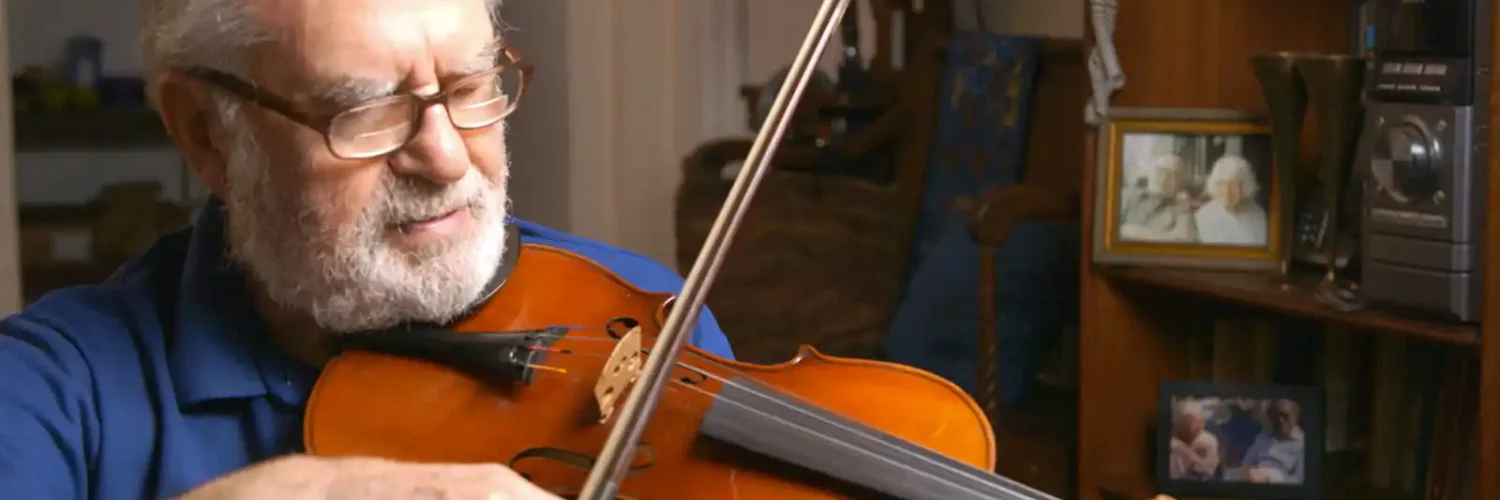

Joe’s Violin is an Oscar-nominated documentary short that tells the inspiring story of Holocaust survivor Joseph Feingold, who donates his cherished violin to a young student in the Bronx. Through music, the film explores themes of resilience, generosity, memory, and the powerful connection between generations.
cMovie.Asia
Joe’s Violin is one of the most emotionally powerful documentary shorts of the decade. Nominated for Best Documentary Short Subject at the 89th Academy Awards, director Kahane Cooperman crafts a deeply human story about memory, survival, music, and unexpected connection across generations.
Table of Contents
Synopsis
The film follows 91-year-old Holocaust survivor Joseph Feingold, who decides to donate the violin he has treasured for more than seventy years. After surviving a Siberian labor camp during World War II, Feingold acquired the instrument in a displaced-persons camp and carried it with him throughout his life in America.
His violin eventually finds a new home with Brianna Perez, a talented 12-year-old student from the Bronx. What begins as a simple donation evolves into an extraordinary relationship between two people separated by generations, cultures, and life experiences, yet united through music.
A Story About More Than Music
At just 24 minutes long, Joe’s Violin accomplishes what many feature-length documentaries struggle to achieve. The film explores the lasting impact of historical trauma while also celebrating hope, resilience, and generosity. Rather than focusing solely on the violin itself, the documentary uses the instrument as a symbol of memory and human connection.
Joseph Feingold’s story is particularly compelling because he chooses to let go of something deeply personal. The violin represents his youth, his family, and his survival after unimaginable hardship. His willingness to pass it on reflects one of the film’s central themes: meaningful legacies are created when memories are shared rather than preserved in isolation.
Direction and Storytelling
Cooperman’s direction is remarkably restrained and effective. The documentary avoids sentimentality, allowing the real-life emotions of its subjects to carry the narrative. Archival history, personal testimony, and contemporary footage blend seamlessly, creating a story that feels both intimate and universal.
The pacing is deliberate, giving viewers enough time to appreciate both Joe’s difficult past and Brianna’s promising future. Their eventual bond becomes the emotional centerpiece of the film, demonstrating how art and music can transcend age, geography, and history.
Why the Film Resonates
Many documentaries about the Holocaust focus on remembrance, while many stories about young musicians focus on aspiration. Joe’s Violin successfully combines both themes. It shows how history can remain relevant through personal relationships and how acts of kindness can ripple across generations.
The film also highlights the importance of arts education. Brianna’s passion for music and her appreciation of the violin’s history demonstrate how access to creative opportunities can profoundly influence young lives.
Oscar Recognition
The documentary premiered at the Tribeca Film Festival and went on to receive numerous festival awards before earning an Academy Award nomination for Best Documentary Short Subject at the 2017 Oscars. Although it did not win the Oscar, its nomination brought wider attention to its inspiring story and emotional impact.
Final Verdict
Joe’s Violin is a beautiful reminder that small acts of generosity can create lasting change. Through a simple exchange of a violin, the documentary bridges decades of history and offers a hopeful message about empathy, remembrance, and the enduring power of music.
Rating: 9/10
For viewers who appreciate heartfelt documentaries, Holocaust survivor stories, and inspiring real-life human connections, Joe’s Violin is essential viewing. Its brief runtime makes its emotional impact even more remarkable, proving that some of the most profound stories can be told in less than half an hour.






Add Short Film Review