










The F-Word review: Alex Cannon’s short film is a witty and emotionally intelligent comedy about a father explaining the F-word to his daughter. Through sharp dialogue and subtle humor, the film explores language, parenting, and human connection with surprising depth and lasting emotional resonance.
cMovie.Asia
- Title: The F-Word
- Director: Alex Cannon
- Running Time: 6 minutes 30 seconds
- Release Year: 2022
- Language: English
- Genre: Comedy , Short Film, Family Comedy, Parenting Drama
The F-Word review reveals why Alex Cannon’s acclaimed short film stands out as one of the smartest comedy shorts in recent years. Built around a father-daughter conversation about a single taboo word, the film transforms a simple premise into a deeply funny and surprisingly moving exploration of language, parenting, and emotional honesty. If you enjoy intelligent short films with sharp writing and strong performances, The F-Word is absolutely worth your attention.
Table of Contents

A deceptively simple premise
The premise sounds almost like the setup to a stand-up routine: a young girl asks her father what the F-word means, and he attempts to give an age-appropriate explanation. But The F-Word quickly reveals that the real subject is not profanity—it is the impossible task of explaining the adult world to a child.
As the father works through the word’s many meanings and uses, the conversation becomes increasingly complex. Every answer creates another question, and every attempt at clarity exposes another layer of ambiguity. The film understands something fundamental about language: words are never just definitions; they are social, emotional, and deeply personal.
Alex Cannon’s greatest strength: precision
Alex Cannon’s direction is remarkably restrained. There are no flashy visual gimmicks or exaggerated comedic set pieces. Instead, the film relies almost entirely on timing, performance, and the escalating logic of conversation.
This precision is what makes the comedy work.
The dialogue feels natural enough to resemble a real parent-child exchange, yet it is carefully structured so that each new explanation pushes the father further into linguistic and emotional quicksand. The humor comes from watching an intelligent adult realize that intelligence alone cannot solve the problem.
Chris Gethard anchors the film beautifully
Chris Gethard gives the kind of performance that short films often struggle to achieve: he makes the character feel complete within a very limited runtime.
His father is not simply embarrassed or confused. He is genuinely trying to do the right thing. That sincerity is essential because it prevents the film from becoming a sketch built around a single joke.
Gethard captures the exhausting mental process familiar to many parents:
- wanting to be honest,
- wanting to protect innocence,
- and realizing that children can dismantle adult logic with terrifying efficiency.
The comedy grows out of his increasing desperation rather than broad slapstick.
The film’s smartest idea: language is unstable
What elevates The F-Word above a typical comedy short is its fascination with how language actually works.
The father tries to define the word, but every definition immediately breaks down because the word functions differently depending on context. It can express pain, surprise, affection, anger, triumph, emphasis, or intimacy. The film quietly demonstrates that language is not a fixed system—it is a negotiation between people.
In that sense, the film becomes less about profanity and more about communication itself.
Children often expect words to have clear meanings.
Adults know they rarely do.
That gap between expectation and reality is where the film finds both its humor and its emotional depth.
Parenting without sentimentality
Many parent-child films rely on sentimental speeches about love and family. The F-Word takes a more interesting approach.
The father and daughter connect through curiosity.
She asks questions because she genuinely wants to understand the world.
He struggles because he genuinely wants to help her understand it.
Their relationship is built on inquiry rather than melodrama.
This makes the emotional payoff feel earned. The film suggests that parenting is not about having perfect answers; it is about remaining present when the answers become impossible.
Why the short runtime works
At around six minutes, The F-Word demonstrates an important lesson in short filmmaking: end before the premise expires.
The concept is explored thoroughly enough to feel satisfying but never stretched beyond its natural limits.
Many feature-length comedies would struggle to sustain this level of comic momentum.
Cannon and his collaborators understand exactly how much material the idea can support, and that discipline is one of the film’s greatest virtues.
A comedy with surprising emotional intelligence
The film’s biggest surprise is that it gradually becomes a story about vulnerability.
As the father attempts to explain the word, he inevitably reveals aspects of himself: his values, his anxieties, his memories, and his uncertainty.
Language becomes a mirror.
The conversation is ostensibly about one word, but it exposes an entire emotional landscape.
This is why the film lingers after it ends.
The joke is funny.
The people are recognizable.
And the emotional truth is unexpectedly universal.
The F-Word review: final verdict
The F-Word is one of those rare comedy shorts that feels both effortless and meticulously crafted. Alex Cannon transforms a familiar parenting dilemma into a witty, insightful meditation on language, honesty, and human connection. The film is consistently funny, sharply written, and emotionally resonant without ever becoming sentimental.
For viewers who appreciate intelligent comedy, strong performances, and short films that respect the audience’s intelligence, The F-Word is absolutely worth watching. It proves that a conversation lasting only a few minutes can contain enough humor and humanity to rival films ten times its length.

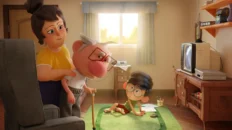
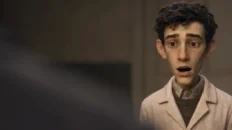



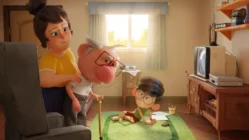
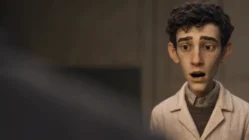


The F-Word is a wonderfully clever short comedy that turns a simple parenting dilemma into something unexpectedly profound. Alex Cannon takes the familiar scenario of a child asking about a forbidden word and transforms it into a sharp, dialogue-driven exploration of language, honesty, and the limits of adult explanations.
Chris Gethard delivers a wonderfully grounded performance as a father trying to navigate an impossible conversation with sincerity rather than easy jokes. The film’s humor comes from its precision: every answer creates a new question, and every attempt at clarity reveals how complicated communication really is.
What makes The F-Word stand out is its emotional intelligence. Beneath the comedy is a thoughtful reflection on parenting, vulnerability, and the challenge of helping children understand a world filled with ambiguity. In just over six minutes, Cannon creates characters who feel authentic and a conversation that feels surprisingly universal.
Smart, funny, and quietly moving, The F-Word proves that a great short film doesn’t need a complex plot to leave a lasting impression. It is a small film with a remarkably big heart.
Rating: 9/10