








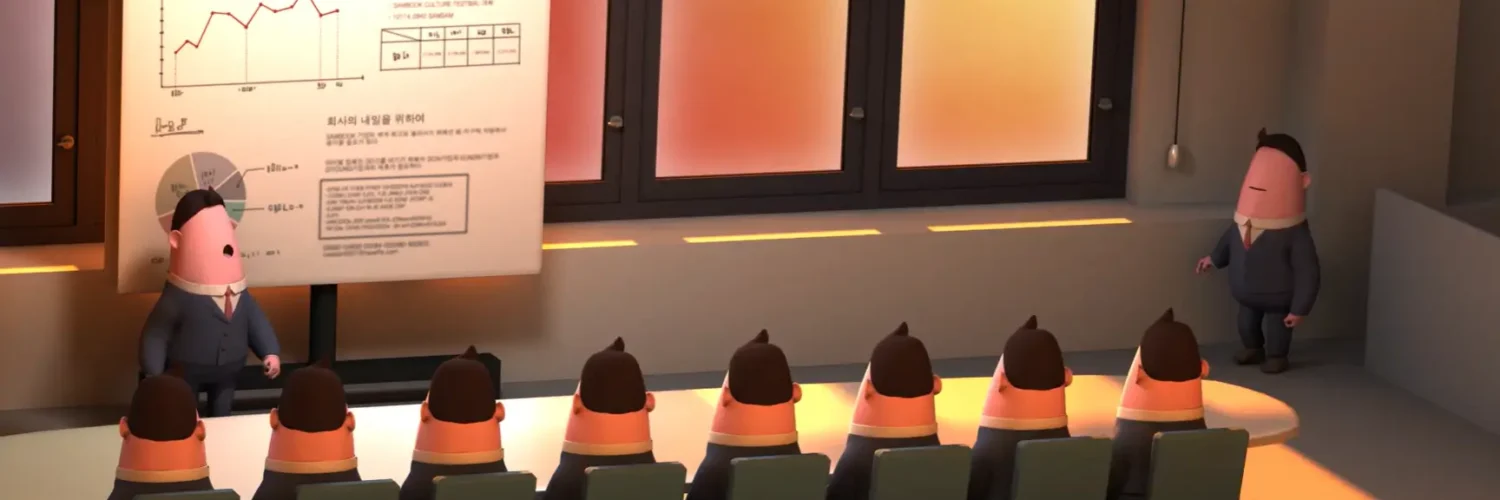

The Master Piece (Geoljak) is a Korean 3D short animation directed by KIM Si-on, LEE Eun-jin, and LEE Ji-young. The film follows a craftsman whose planet-shaped creation unexpectedly produces humanity, leading to a fascinating story about creation, control, responsibility, and unintended consequences.
cMovie.Asia
The Master Piece (걸작, Geoljak) is a Korean 3D animated short film directed by KIM Si-on, LEE Eun-jin, and LEE Ji-young. At approximately nine minutes long, the film presents a deceptively simple premise: humans are accidentally created by a craftsman making a planet-shaped piece of pottery, and the frustrated craftsman eventually tries to destroy the world he has created. Yet the film’s real strength lies in the questions hidden beneath that simple story—who has the right to create, who has the right to destroy, and what happens when a creator loses control of the thing he made?
The film is particularly notable because it was selected in the Animation Division of the 24th Japan Media Arts Festival. The festival describes it as a work that can be understood by children while carrying meanings that resonate with adults, making The Master Piece an interesting example of Korean independent animation that uses a compact visual concept to explore much larger ideas.
Important date note: Some Korean film databases list The Master Piece as a 2020 film, while the Korean Film Council’s English database and Fantasia-related material identify it as 2019. For this article, “2020” follows the Korean independent-film listings and the date commonly associated with the film in festival and educational contexts.
Table of Contents
What Is The Master Piece About?
At its most basic level, The Master Piece is a story about creation and unintended consequences.
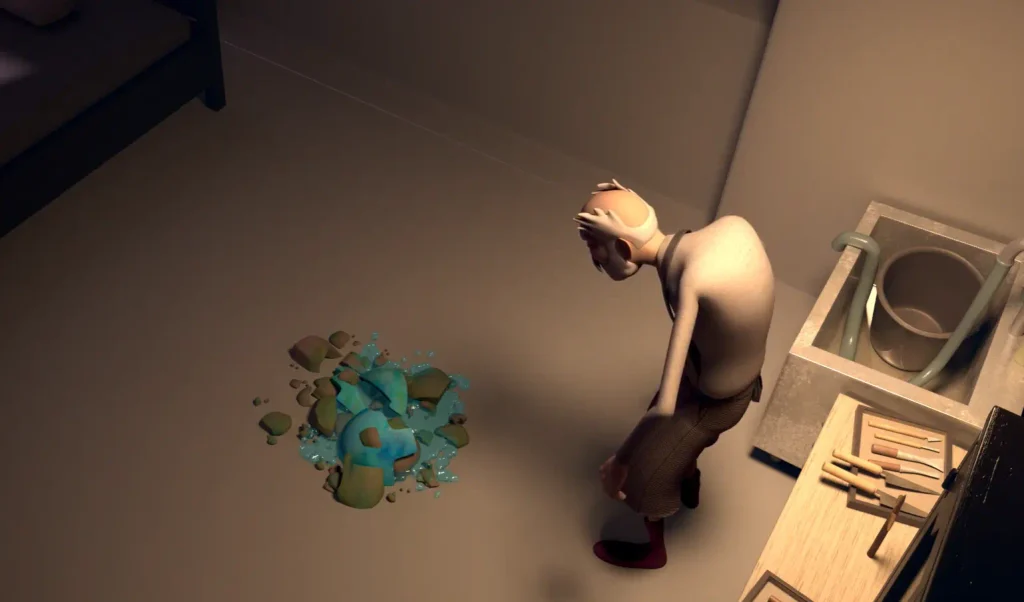
A craftsman spends the night creating a piece of pottery shaped like a planet. During the process, human beings unexpectedly emerge from his creation. Instead of celebrating this unexpected result, the craftsman becomes frustrated by the problems and noise caused by humans.
He attempts to get rid of them.
His efforts fail.
Eventually, he throws the Earth onto the floor and destroys it. But the destruction does not produce the result he expects. When he wakes up the following day, human society has spread across the floor.
That central sequence is confirmed by the Japan Media Arts Festival’s official description of the film.
The important point is that the film does not require a complicated mythology or extensive dialogue to establish its central conflict. The visual relationship between the craftsman, the planet, and humanity does most of the storytelling.
That economy is one of the defining strengths of a successful short animation.
The Master Piece at a Glance
| Category | Details |
|---|---|
| Korean title | 걸작 (Geoljak) |
| English title | The Master Piece |
| Format | Animated short film |
| Country | South Korea |
| Approx. running time | 9 minutes |
| Directors | KIM Si-on, LEE Eun-jin, LEE Ji-young |
| Animation | 3D |
| Major recognition | 24th Japan Media Arts Festival, Animation Division Jury Selection |
Korean independent-film listings classify The Master Piece as a 2020 short animation, while a Korean film database lists its running time as nine minutes. A Korean animation industry document also identifies the film as a 2020 3D animation by the three directors and records its selection at the 24th Japan Media Arts Festival.
Who Directed The Master Piece?
The film was jointly directed by KIM Si-on, LEE Eun-jin, and LEE Ji-young.
The three names appear together in official festival documentation. The Japan Media Arts Festival identifies all three as the creators of The Master Piece, while the Korean Film Council also credits KIM Si-on, LEE Eun-jin, and LEE Ji-young as directors.
The collaborative nature of the project is worth noting because independent animation frequently requires creators to work across multiple stages of production rather than functioning within the highly specialized production structures common to major commercial animated features.
For audiences unfamiliar with Korean independent animation, The Master Piece therefore provides a useful introduction to a different side of Korea’s animation culture—one that emphasizes short-form storytelling, visual metaphor, and festival-oriented creative work rather than franchise entertainment.
Why Is the Title “The Master Piece” Significant?
The title creates an immediate conceptual question.
A “masterpiece” traditionally refers to an exceptionally accomplished work created by an artist or craftsperson. In The Master Piece, however, the craftsman’s greatest creation becomes the source of his frustration.
The planet he creates is not simply an object.
It becomes a living environment.
Human beings emerge from it, develop society, and ultimately become something the creator can no longer fully control.
This creates an interesting tension between artistic intention and independent existence.
A creator may begin with a specific purpose, but once the creation becomes autonomous, its meaning can change.
The film therefore works on two levels:
- Literal level: A craftsman creates a planet and accidentally produces humanity.
- Symbolic level: A creator attempts to control the consequences of creation but discovers that creation can develop beyond its original intention.
This second level is what makes the film particularly suitable for adult viewers.
The Japan Media Arts Festival explicitly notes that although the story is simple enough for children, it contains meanings for adults.
The Creator and the Created
One of the most useful ways to interpret The Master Piece is through the relationship between creator and creation.
The craftsman initially appears to have absolute power.
He makes the planet.
He observes the humans.
He becomes dissatisfied with them.
He attempts to eliminate them.
From his perspective, the relationship is straightforward: because he created them, he should be able to determine whether they continue to exist.
But the film undermines that assumption.
Humanity becomes increasingly difficult to control.
Even destruction fails to restore the craftsman’s original intention.
This creates a broader question:
Does creating something automatically give the creator permanent control over it?
The film does not provide a philosophical essay answering that question. Instead, it uses visual storytelling to let the audience consider it.
That is one reason the premise remains effective despite its extremely short running time.
A Story About Humanity Without Making Humanity the Hero
Another interesting feature is the film’s treatment of human beings.
In many stories about the origins of humanity, humans are automatically positioned as protagonists. The audience is encouraged to identify with them.
The Master Piece takes a different approach.
The humans are initially perceived from the outside—from the perspective of their creator.
To the craftsman, humanity is not necessarily a miracle. It is a problem.
That shift in perspective changes the meaning of familiar human behavior.
Noise, social activity, growth, and civilization can look very different depending on who is observing them.
For viewers, this creates an unusual form of distance. Rather than asking only, “What is happening to these humans?”, the film encourages another question:
“What does humanity look like to someone—or something—that created us?”
This reversal gives the short film much of its conceptual power.
Why the Film Works as a Short Animation
Short films have an unusual storytelling challenge.
A feature film can spend two hours establishing a fictional world, developing characters, and gradually introducing its central conflict.
A nine-minute animation cannot.
It has to communicate quickly.
The Master Piece solves this problem by building the entire narrative around a single strong visual metaphor: a craftsman making a planet as if it were pottery.
The metaphor immediately establishes several relationships:
- The planet becomes an object.
- The craftsman becomes a creator.
- Humanity becomes an unexpected product of creation.
- Civilization becomes an unintended consequence.
- Destruction becomes an attempt to restore control.
Because these relationships are visually understandable, the film does not need extensive exposition.
This is a particularly effective approach for animation because animation can transform abstract philosophical concepts into physical images.
A planet can literally be treated like pottery.
Humanity can literally appear as part of the creator’s work.
And the destruction of the planet can function simultaneously as a plot event and a symbolic gesture.
The Role of 3D Animation
Korean industry documentation identifies The Master Piece as a 3D animation.
That technical choice is significant because the film’s premise depends heavily on physical relationships.
The audience needs to understand the planet as an object that can be:
- shaped,
- examined,
- handled,
- damaged,
- and destroyed.
The physicality of the world supports the central metaphor.
Rather than separating “the real world” from “the created world,” the film presents the planet itself as a crafted object. This makes the distinction between art and reality deliberately unstable.
That is an effective use of animation technique: the visual form reinforces the story’s underlying idea rather than existing simply as decoration.
The Film’s Environmental Interpretation
Although it would be too strong to claim that the directors intended a specific environmental message without a direct statement from them, the film can reasonably be read through an environmental lens.
The premise places humanity inside a world that is literally created as an object.
Humans then multiply and transform that environment.
The creator becomes frustrated with the consequences and attempts to eliminate the problem by destroying the world itself.
This can invite comparisons with real-world questions about:
- human impact on the planet,
- environmental destruction,
- resource consumption,
- unintended consequences,
- and the difficulty of reversing ecological damage.
However, these should be understood as interpretive possibilities, not confirmed statements of authorial intent.
That distinction matters when discussing a film responsibly.
A strong film analysis separates what the creators or official sources establish from what viewers may reasonably interpret.
A Story About Control
Perhaps the most universal theme in The Master Piece is control.
The craftsman begins with complete control.
Then humanity appears.
The craftsman attempts to regain control.
The attempts fail.
Finally, he destroys the planet.
And even that does not produce the outcome he expects.
The irony is powerful: the more aggressively the craftsman attempts to control his creation, the less successful he becomes.
This can be interpreted in many contexts.
Parents sometimes discover that children eventually make independent choices. Artists discover that audiences interpret their work differently from what they intended. Engineers discover that complex systems produce unexpected behavior. Governments discover that social systems cannot always be controlled through simple intervention.
The film’s metaphor therefore extends beyond its fantasy setting.
Why Adults May Read the Film Differently From Children
The Japan Media Arts Festival makes an especially important observation: the story is simple enough for children but contains meanings for adults.
For a younger viewer, the story may simply be:
A strange craftsman creates humans, becomes angry with them, and tries to get rid of them.
For an adult, the same story can raise more complicated questions.
What responsibilities does a creator have toward what they create?
When does protection become control?
Can a creator reject the consequences of creation?
What happens when something develops beyond its original purpose?
Why do humans so often try to solve complex problems by removing the thing they perceive as the problem?
The film does not need to answer all of these questions.
Its achievement is creating enough conceptual space for the audience to ask them.
International Recognition: Japan Media Arts Festival
One of the strongest pieces of evidence for the film’s artistic significance is its inclusion in the 24th Japan Media Arts Festival Animation Division Jury Selections.
The official festival archive lists The Master Piece alongside selected works from Japan and other countries, including animated shorts, music videos, and other animation formats.
This was not the festival’s Grand Prize or Excellence Award. It was specifically a Jury Selection, so it is important not to describe the film as a Grand Prize winner.
That distinction is essential for accurate film writing.
The festival’s jury commentary also emphasized the value of short animation as a concentrated form capable of carrying creators’ ideas and imagination within a limited duration.
In that context, The Master Piece fits naturally into the festival’s recognition of distinctive animated works that communicate ideas through different visual and narrative approaches.
The Master Piece and Korean Independent Animation
Korean animation is often discussed internationally through commercial animation, web animation, character IP, or the country’s wider entertainment industry.
Independent short animation tells a different story.
Works such as The Master Piece demonstrate how Korean animation creators use short-form production to experiment with:
- metaphor,
- visual storytelling,
- philosophical ideas,
- unconventional characters,
- and compact narrative structures.
The film was also included in a Korean short-animation program presented internationally by the Korean Cultural Center in India. The program described The Master Piece alongside several other Korean independent animated shorts and presented the works to international audiences online.
That international circulation is important because short animation festivals and cultural programs provide opportunities for films that may not receive the same commercial exposure as feature-length productions.
Is The Master Piece Worth Watching?
Yes—especially if you enjoy short animation with a philosophical premise rather than conventional character-driven storytelling.
The film is particularly interesting for viewers who enjoy:
- Korean independent animation
- philosophical short films
- experimental storytelling
- 3D animated shorts
- films about humanity and creation
- animation festival selections
- stories with environmental or existential interpretations
- films that can be understood differently by children and adults
Its short running time also makes it an accessible introduction to Korean independent animation.
Rather than requiring a large time commitment, the film uses a compact premise to encourage discussion after the story ends.
Frequently Asked Questions
What is The Master Piece (Geoljak)?
The Master Piece, or 걸작 (Geoljak)**, is a Korean animated short about a craftsman who creates a planet-shaped pottery object from which humans unintentionally emerge. The craftsman becomes frustrated with humanity and attempts to eliminate it.
Who directed The Master Piece?
The film was co-directed by KIM Si-on, LEE Eun-jin, and LEE Ji-young.
How long is The Master Piece?
The film is approximately nine minutes long. A Korean film database lists its running time as nine minutes, while a Korean Cultural Center screening listing gives a more precise duration of 9 minutes 14 seconds.
Is The Master Piece a Korean film?
Yes. Official festival records identify the film as a work from South Korea.
Did The Master Piece win an award?
It was selected for the Jury Selections of the Animation Division at the 24th Japan Media Arts Festival. It should not be described as the festival’s Grand Prize or Excellence Award winner.
What does The Master Piece mean?
The film can be interpreted as an exploration of creation, control, unintended consequences, and the relationship between creators and their creations. The official Japan Media Arts Festival description specifically notes that its simple story has meanings for adult audiences as well as children.
Why is the film called “The Master Piece”?
The title is closely connected to the craftsman’s creation. The irony is that what begins as a crafted planetary object becomes something living and uncontrollable. The “masterpiece” therefore raises questions about whether a creator can truly control the meaning and consequences of a creation.
Final Takeaway
The Master Piece (Geoljak) is a remarkably compact Korean animated film built around an immediately understandable but surprisingly deep idea: what happens when a creator loses control of a creation?
Its nine-minute structure does not attempt to build an elaborate fictional universe. Instead, KIM Si-on, LEE Eun-jin, and LEE Ji-young construct a simple visual relationship between a craftsman, a planet, and humanity. That simplicity gives the film room to operate on multiple levels—as a children’s story, a philosophical fable, and a metaphor about responsibility and unintended consequences.
Its selection by the 24th Japan Media Arts Festival confirms that the film received international recognition within a major media-arts context.
For viewers interested in Korean independent animation, The Master Piece is therefore more than a brief animated short. It is an example of how a carefully chosen visual metaphor can communicate an idea far larger than its running time—and how animation can turn an abstract philosophical question into something audiences can immediately see.



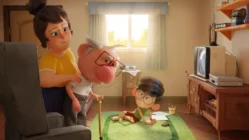


The Master Piece (Geoljak) is a clever Korean 3D animated short that packs a surprisingly big idea into roughly nine minutes. The film follows a craftsman whose planet-shaped creation unexpectedly gives rise to humanity, leading to a darkly humorous conflict between creator and creation.
What makes the film memorable is its simple but effective visual metaphor. Rather than relying on lengthy dialogue or complicated world-building, the directors use animation to explore creation, control, responsibility, and unintended consequences. The story can be enjoyed as a straightforward animated tale, but adult viewers may also find deeper questions about humanity and the consequences of creation.
Overall, The Master Piece is a smart, imaginative, and thought-provoking short animation that leaves viewers with more questions than answers—and that is precisely what makes it worth watching.