








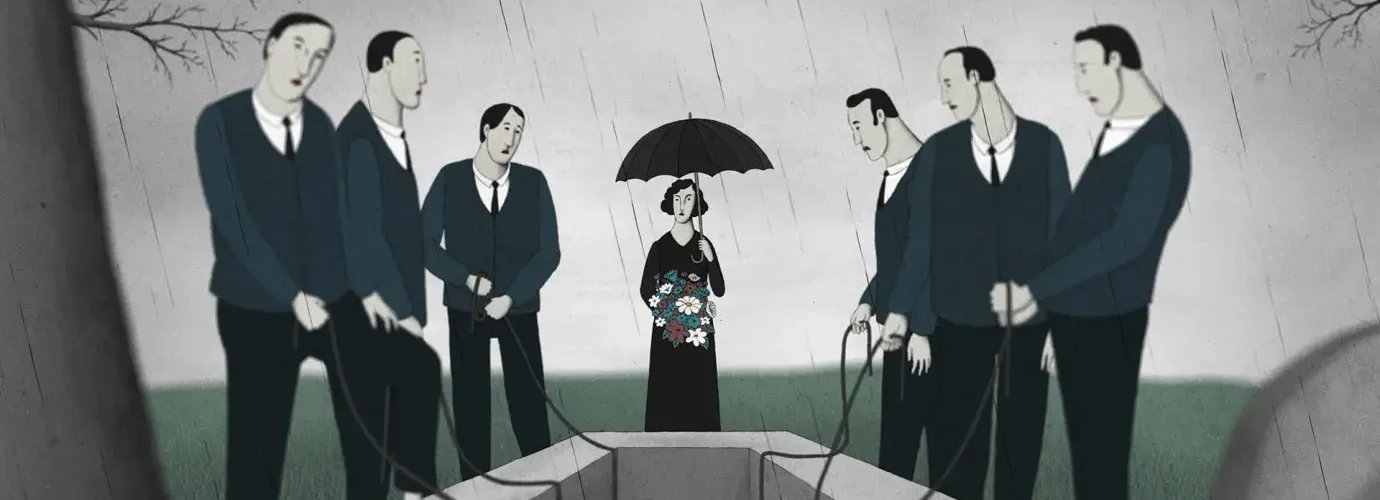

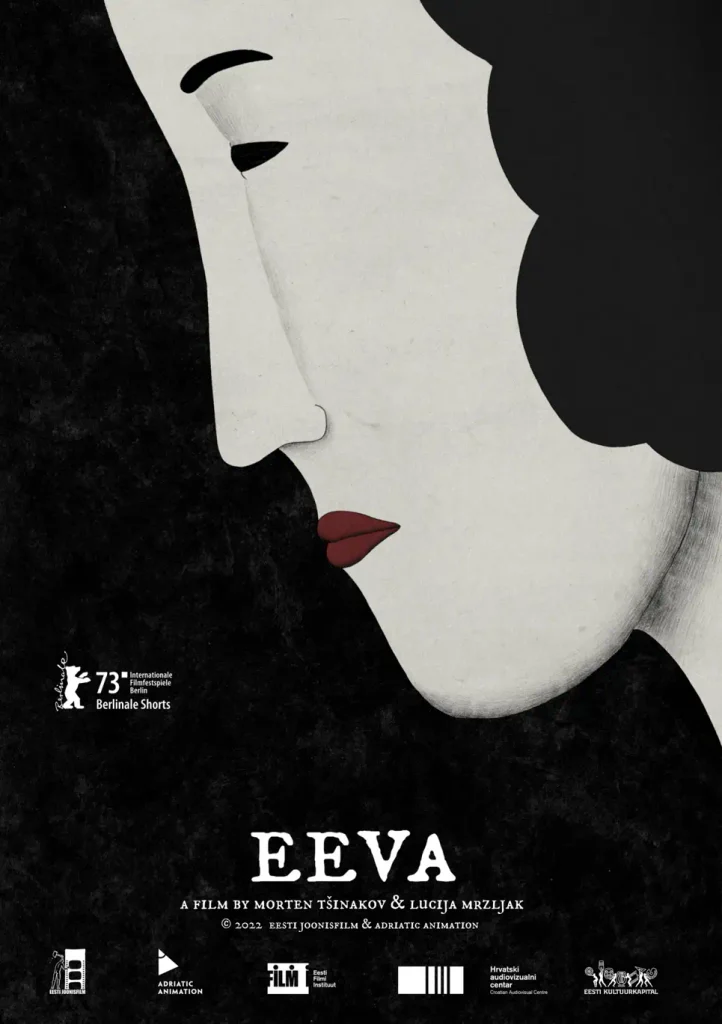
Eeva (2022) is a surreal Croatian-Estonian animated short directed by Morten Tšinakov and Lucija Mrzljak. Set around a woman’s husband’s funeral, the 16-minute film explores grief, loneliness, emotional repression, death, and the absurdity of mourning through dark humor, dreamlike imagery, and expressive animation.
cMovie.Asia
- Genre: Animation, Drama, Social Satire, Fantasy
- Runtime: 15 minutes 58 seconds
- Country: Estonia / Croatia
- Year: 2022
- Director: Morten Tšinakov, Lucija Mrzljak
- Main Theme: Grief, death, loneliness, emotional repression, social expectations, dreams, and the absurdity of mourning
- Language: Estonian / No dialogue in some festival listings
- Screenplay: Morten Tšinakov
- Production: Adriatic Animation / Eesti Joonisfilm
- Notable Recognition: Annecy 2023 Alexeïeff–Parker Award; selected for Berlinale Shorts 2023
Eeva (2022) is the kind of animated short film that can leave you uncomfortable long after the credits end. Directed by Croatian-Estonian filmmakers Morten Tšinakov and Lucija Mrzljak, this nearly 16-minute film transforms a funeral into an unsettling, darkly comic meditation on grief, loneliness, emotional repression, and the strange ways people behave when confronted with death.
At first glance, Eeva appears to tell a relatively simple story: a woman attends her husband’s funeral on a rainy day. There are mourners, umbrellas, tears, wine, and the expected rituals surrounding death.
But almost immediately, something feels wrong.
The mourners’ behavior becomes increasingly strange. Reality begins to bend. Dreams, memories, absurdity, violence, and grief begin to overlap. What starts as a funeral story gradually becomes something much more psychologically disturbing.
The result is an unusual piece of European animation that refuses to explain everything to its audience.
And that is precisely what makes Eeva so compelling.
Table of Contents
What Is Eeva About?
Eeva follows a woman named Eeva on what should be the saddest day of her life: the funeral of her husband.
The official synopsis describes a funeral in pouring rain, with “a lot of crying, too much wine, several woodpeckers and a couple of dreams that fill in the gaps.” The film was produced by Croatia’s Adriatic Animation and co-produced by Estonia’s Eesti Joonisfilm. It runs approximately 15 minutes and 58 seconds and combines CGI, classical animation, and 2D techniques.
That synopsis sounds almost playful.
The actual film is anything but conventional.
Eeva is surrounded by people who appear to be mourning, yet their reactions don’t always feel sincere. There is a strange theatricality to the funeral. The characters seem trapped inside social expectations about how grief is supposed to look.
Eeva herself doesn’t behave in the way we might expect.
Instead of presenting grief as a straightforward emotional journey, the filmmakers turn it into something physical, absurd, grotesque, and occasionally horrifying.
The funeral becomes less a realistic representation of mourning and more a window into Eeva’s fractured emotional state.
A Film About Grief Without Explaining Grief
One of the strongest aspects of Eeva is that it doesn’t attempt to define grief.
There is no long speech explaining how Eeva feels.
There is no conventional psychological monologue.
There is no narrator telling us what the protagonist is thinking.
Instead, the filmmakers communicate grief through behavior, imagery, sound, color, rhythm, and surreal events.
This approach is particularly effective because grief itself rarely behaves logically.
A person can cry uncontrollably one moment and feel completely numb the next.
Someone can laugh at an inappropriate moment.
Someone can become angry.
Someone can drink too much.
Someone can become obsessed with an insignificant detail.
Someone can experience memories as if they were happening in the present.
Eeva understands this contradiction.
The film doesn’t make grief neat.
It makes grief strange.
The Surrealism Is the Point
If you’re expecting a conventional animated short about bereavement, Eeva may initially seem confusing.
The film introduces unusual events and images without always providing an obvious explanation.
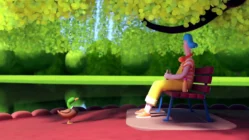
A woodpecker plays a particularly memorable role, and the filmmakers have revealed that this strange element actually originated from a dream Morten Tšinakov had.
According to an interview published by Berlinale Shorts, Tšinakov dreamed of a woodpecker landing on a coffin and communicating a message in Morse code before being killed with an umbrella. That dream was incorporated into the film almost unchanged.
Knowing this makes the film’s surrealism easier to understand.
The bizarre imagery isn’t random simply for the sake of being bizarre.
It comes from the logic of dreams.
And dreams don’t follow the rules of ordinary storytelling.
A woodpecker can become a messenger.
A funeral can turn into something resembling a grotesque performance.
A memory can suddenly feel more real than the present.
The dead and the living can seem separated by almost nothing.
This dreamlike logic gives Eeva its distinctive identity.
Why the Animation Style Works So Well
Visually, Eeva is immediately recognizable.
The film doesn’t attempt to imitate glossy mainstream animation.
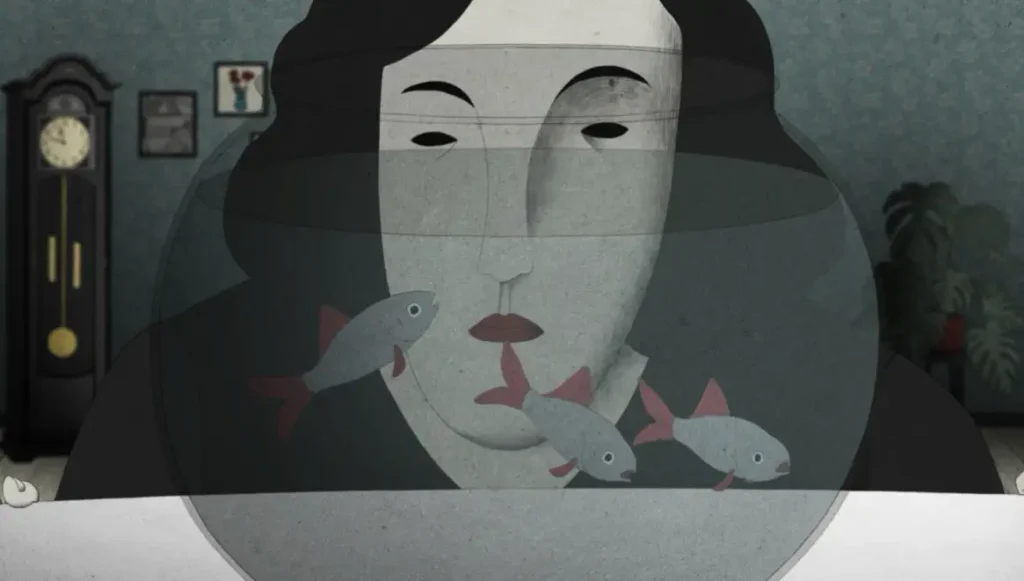
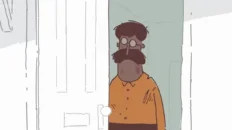
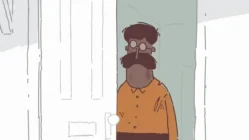
Instead, it embraces a stylized 2D aesthetic with muted surroundings, strong visual contrasts, expressive character designs, and an intentionally unsettling atmosphere.
The Croatian Audiovisual Centre classifies the film as a combination of CGI, classical animation, and 2D animation.
The visual design is especially effective because the world often feels simultaneously realistic and artificial.
The people look like people.
The funeral looks like a funeral.
The cemetery feels recognizable.
But everything has been pushed slightly away from reality.
Faces, gestures, movement, and environments have an exaggerated quality.
This makes the audience feel that something is fundamentally wrong even before the story becomes explicitly disturbing.
The filmmakers have essentially created a visual representation of emotional instability.
The Importance of Color
Color plays an important role in creating the atmosphere of Eeva.
Much of the world is subdued, with pale and muted tones dominating the screen.
Against this restrained palette, stronger colors become emotionally significant.
The filmmakers have discussed their visual approach and specifically mentioned the influence of Wong Kar-wai’s use of powerful reds and greens. They began with red and green and developed the rest of the palette around those choices, eventually finding that muted colors and gray worked particularly well together.
That decision gives Eeva a distinctive visual tension.
The film looks almost washed out, as though the world itself has been drained of vitality.
Then certain colors emerge.
The effect is subtle but powerful.
Rather than using color simply for beauty, the filmmakers use it as part of the emotional language of the story.
Dark Humor Makes the Film Even More Uncomfortable
Perhaps the most interesting thing about Eeva is that it is not simply a sad film.
It is also funny.
But the humor is extremely dark.
There are moments when you may find yourself laughing before realizing that what you’re laughing at is actually disturbing.
This combination of tragedy and absurdity is central to the film’s identity.
Zippy Frames described Eeva as a highly stylized, sensually dense exercise in absurd dramatic comedy with dark humor.
That description captures the film well.
The filmmakers understand that absurdity can make tragedy more powerful.
When everything becomes too serious, audiences sometimes become emotionally distant.
But when something unexpectedly funny happens in the middle of grief, it can make the emotional experience even more uncomfortable.
You don’t know whether you’re supposed to laugh or feel horrified.
Eeva deliberately keeps you in that uncomfortable space.
The Film’s View of Social Expectations Around Grief
One of the film’s deeper themes is the expectation that people should perform grief in an acceptable way.
At a funeral, everyone understands the social rules.
You should look sad.
You should show respect.
You should behave appropriately.
You should cry when someone dies.
But what happens when a person’s internal emotional experience doesn’t match those expectations?
That question seems to sit at the center of Eeva.
In an interview with Animation Scoop, Tšinakov explained that the filmmakers were interested in how people behave during difficult emotional situations. He also noted that people often feel pressure to display a standard set of visible emotions, even though everyone deals with difficult experiences differently.
That idea gives the film considerably more depth.
Eeva’s behavior isn’t simply strange.
It challenges our assumptions about what grief is supposed to look like.
Eeva’s Funeral Is Almost Like a Stage
There is something theatrical about the film’s funeral.
The mourners appear almost like actors participating in a ritual.
Everyone knows their role.
Everyone knows what they are supposed to do.
But underneath that performance is something much less controlled.
Alcohol, desire, anger, guilt, memory, loneliness, and death gradually disrupt the social ceremony.
This creates one of the film’s strongest contrasts:
public grief versus private grief.
Public grief is structured.
Private grief is chaotic.
The funeral attempts to create order around death, while Eeva’s internal world becomes increasingly disordered.
The film doesn’t need to explain this conflict.
It shows it.
Sound Is Just as Important as the Images
Animation often gets discussed primarily in terms of visuals.
With Eeva, that would be a mistake.
Sound is essential to the experience.
The film uses music, environmental sound, crying, movement, physical noises, and moments of uncomfortable silence to create its atmosphere.
Berlinale’s press materials specifically highlighted how much sound the film contains despite its wordless or near-wordless approach, emphasizing music, grunting, and smashing alongside the visual storytelling.
This is one reason the film feels surprisingly physical.
You don’t simply watch the characters.
You hear their world.
The sound design helps turn ordinary actions into something threatening.
A small movement can suddenly feel violent.
A quiet scene can become tense.
A piece of music can transform an otherwise absurd moment into something genuinely sad.
The soundtrack is not decoration.
It is part of the storytelling.
A Short Film That Trusts Its Audience
One of the biggest strengths of Eeva is that it doesn’t explain every image.
Modern storytelling often feels obligated to answer every question.
Why did this happen?
What does this symbol mean?
What is the character thinking?
What exactly happened?
Eeva isn’t interested in providing all those answers.
The directors have embraced the freedom of the short-film format.
In their Berlinale interview, they explained that short films give filmmakers more room to experiment because they aren’t necessarily expected to achieve the same commercial success as feature films. That freedom allows them to pursue unusual or absurd ideas without worrying whether every viewer will understand them.
That philosophy is visible throughout Eeva.
The film isn’t trying to please everyone.
It wants to create a particular emotional experience.
And it succeeds.
The Relationship Between Reality and Dreams
Dream sequences are especially important to the film.
Rather than clearly separating dreams from reality, Eeva allows the two to bleed into one another.
This is appropriate because grief can make reality feel dreamlike.
After losing someone close, familiar spaces can suddenly feel unfamiliar.
Ordinary objects can become emotionally charged.
Memories can arrive unexpectedly.
Time can seem distorted.
The past can become more vivid than the present.
The film’s dream sequences therefore aren’t merely surreal interludes.
They reflect the instability of Eeva’s emotional world.
The filmmakers have specifically identified the dream sequences as some of their favorite parts of the finished film.
The Woodpecker: Absurdity With Meaning
The woodpecker may be the most memorable recurring image in Eeva.
At first, it seems almost ridiculous.
Why a woodpecker?
Why at a funeral?
Why does it behave this way?
But that uncertainty is part of the film’s appeal.
The woodpecker originated from Tšinakov’s dream, but within the film it becomes something larger: an intrusion of the irrational into a world attempting to maintain order.
The funeral says:
This is how death is supposed to be handled.
The woodpecker says:
Reality doesn’t care about your rules.
That contrast is quintessentially Eeva.
A Strong Example of European Animated Cinema
Eeva is also worth watching because it represents a very different tradition from mainstream American animation.
There is no emphasis on franchise characters, broad family entertainment, or conventional three-act storytelling.
Instead, the film belongs to a European art-animation tradition where visual experimentation, symbolism, absurdity, and ambiguity are central.
It is also a collaboration between Croatian and Estonian animation cultures.
The production involved Croatia’s Adriatic Animation and Estonia’s Eesti Joonisfilm.
Tšinakov and Mrzljak had already collaborated on A Demonstration of Brilliance in Four Acts and The Stork, making Eeva their third collaboration as a directing duo.
Their shared creative language is particularly visible in the film’s strange combination of melancholy, grotesque humor, surrealism, and highly controlled visual design.
Festival Recognition and Oscar Attention
Eeva was not simply an underground curiosity.
The film received significant international festival exposure.
It premiered internationally through the festival circuit and was selected for Berlinale Shorts, while also appearing in major animation and film festivals including Annecy, Zagreb, Ottawa, Uppsala, and others.
More significantly, Eeva became one of the 15 films shortlisted for the 2024 Academy Award for Best Animated Short Film.
That recognition makes sense.
The film demonstrates something the best animated shorts understand very well:
Animation doesn’t need to imitate live action.
It can show emotions and ideas that would be much harder to communicate through conventional filmmaking.
Eeva uses animation not because the story requires animation, but because animation gives the filmmakers complete control over reality.
And for a story about grief and emotional instability, that freedom is invaluable.
Is Eeva Suitable for Everyone?
Definitely not.
Although Eeva is only around 16 minutes long, it can be emotionally intense.
The film contains dark humor, death, disturbing imagery, surreal violence, alcohol-related behavior, and unsettling animal imagery.
Some viewers may find the film fascinating.
Others may find it excessively bleak or difficult to interpret.
That division is part of its nature.
A review from Eye for Film praised the film’s stark treatment of grief and its crisp animation, while also emphasizing the extreme nature of Eeva’s reaction.
Another review noted that some of the imagery can be difficult to watch but praised the film’s animation, score, editing, and exploration of grief.
So if you prefer straightforward animated stories with clear emotional resolutions, Eeva may frustrate you.
If you enjoy surreal animation, European arthouse cinema, dark comedy, and films that leave room for interpretation, it is much more likely to stay with you.
Eeva Review: What Works Best?
The Visual Design
The film’s strongest quality may be its visual identity.
It looks unlike conventional mainstream animation and uses its muted palette and expressive character design to create a haunting atmosphere.
The Sound
The combination of music and sound design makes the film feel physical and immediate.
The Dark Humor
The humor prevents the film from becoming a straightforward grief drama.
Instead, it becomes unpredictable and uncomfortable.
The Surrealism
The film’s dream logic allows the filmmakers to communicate emotional truths without explaining them.
The Short Runtime
At approximately 16 minutes, Eeva doesn’t overstay its welcome.
Every strange image arrives quickly, making the experience feel almost like a fever dream.
What Doesn’t Work?
The same qualities that make Eeva interesting can also make it difficult.
The film is intentionally ambiguous.
Some viewers may find the symbolism too obscure.
The transitions between reality and dream can occasionally feel abrupt.
The grotesque imagery will also be too much for some audiences.
There are moments when the film seems more interested in creating a mood than advancing a conventional narrative.
But this isn’t necessarily a flaw.
It depends on what you want from a short film.
If you expect a traditional story with a clearly defined beginning, middle, and ending, Eeva may feel frustrating.
If you view it as an emotional and visual experience, its structure becomes much more understandable.
Final Verdict
Eeva is a strange, beautiful, disturbing, and surprisingly funny animated short about grief.
It takes one of the most universally painful human experiences—losing someone you love—and refuses to portray it in a conventional way.
Instead, Morten Tšinakov and Lucija Mrzljak give us rain, funerals, wine, woodpeckers, dreams, awkward social rituals, absurd comedy, violence, and silence.
Some of these elements are funny.
Some are horrifying.
Some are difficult to understand.
Together, however, they create something that feels emotionally authentic.
Because grief itself is often like that.
It isn’t elegant.
It isn’t predictable.
It doesn’t follow a script.
And it certainly doesn’t always look the way other people expect it to look.
That may be the real power of Eeva.
The film isn’t simply asking us to understand Eeva’s grief.
It is asking us to accept that grief can take forms we don’t understand.
At just under 16 minutes, Eeva manages to create an entire psychological universe around one woman’s loss. Its unusual animation, dark humor, dream imagery, and unsettling sound design make it a memorable example of contemporary European short animation.
Rating: 8.5/10
Should You Watch Eeva?
Yes—especially if you enjoy experimental animation, dark comedy, surreal storytelling, and emotionally challenging short films.
It may not provide easy answers, but that’s exactly why it works.
Eeva is less a conventional story about death than a disturbing little dream about what happens when the rituals surrounding death can no longer contain the emotions underneath.
And once the funeral is over, the strange images of Eeva are likely to remain in your mind.






Add Short Film Review