


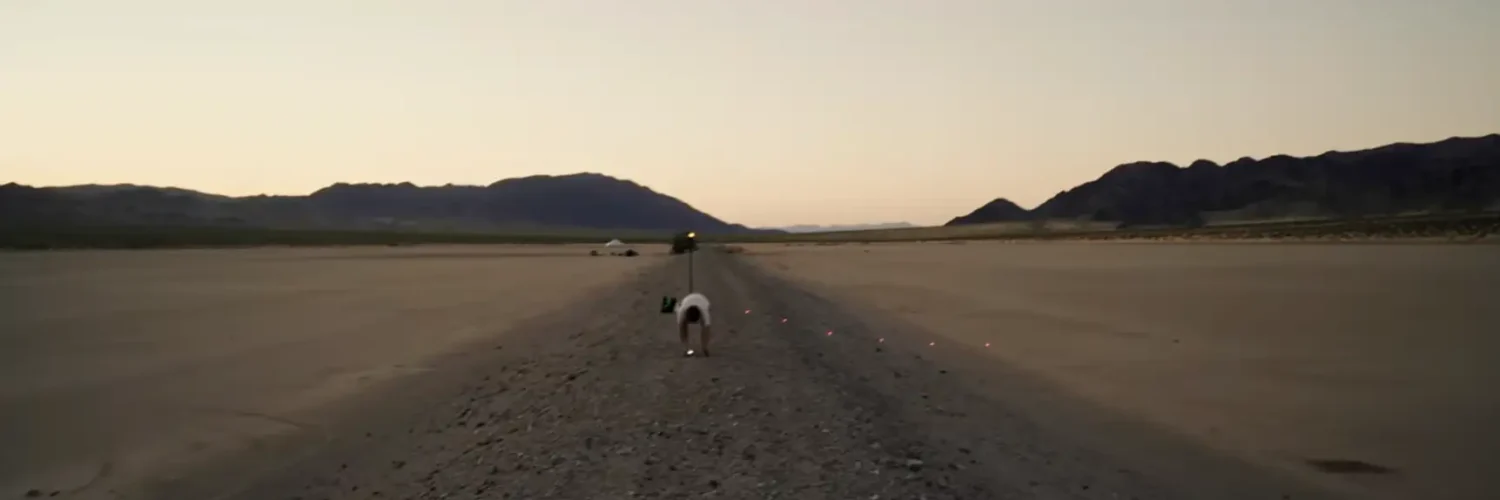

To Scale: TIME by Alex Gorosh is a short documentary that visualizes the universe’s 13.8-billion-year history through an illuminated 4.3-mile timeline in California’s Mojave Desert. Created with Wylie Overstreet, the film reveals how recently Earth, human civilization, and individual human lives appeared in cosmic history.
cMovie.Asia
How can we understand something as enormous as 13.8 billion years when the average human life lasts only a few decades? Numbers alone are rarely enough to communicate the true scale of cosmic history. Even imagining millions or billions of years is difficult because human experience is built around much shorter periods: days, years, generations, and centuries.
To Scale: TIME (2023), directed by Alex Gorosh and created with filmmaker Wylie Overstreet, offers an extraordinary way to understand this difference. Rather than relying entirely on computer graphics or abstract scientific explanations, the approximately 10-minute documentary constructs a physical timeline across a dry lakebed in California’s Mojave Desert. Small lights represent major moments in the history of the universe, transforming billions of years into a distance that viewers can actually see.
The result is both an accessible science demonstration and a thought-provoking reflection on humanity’s place in cosmic history. It illustrates how galaxies, stars, planets, life, and human civilization emerged across an almost incomprehensible span of time—and how brief an individual human lifetime becomes when measured against that history.
For anyone interested in astronomy, science communication, the origins of life, or the meaning of time, To Scale: TIME provides a memorable visual experience that makes the history of the universe easier to comprehend.
Film: 2023 · Director: Alex Gorosh · Writer: Wylie Overstreet · Runtime: Approximately 10 minutes
Table of Contents
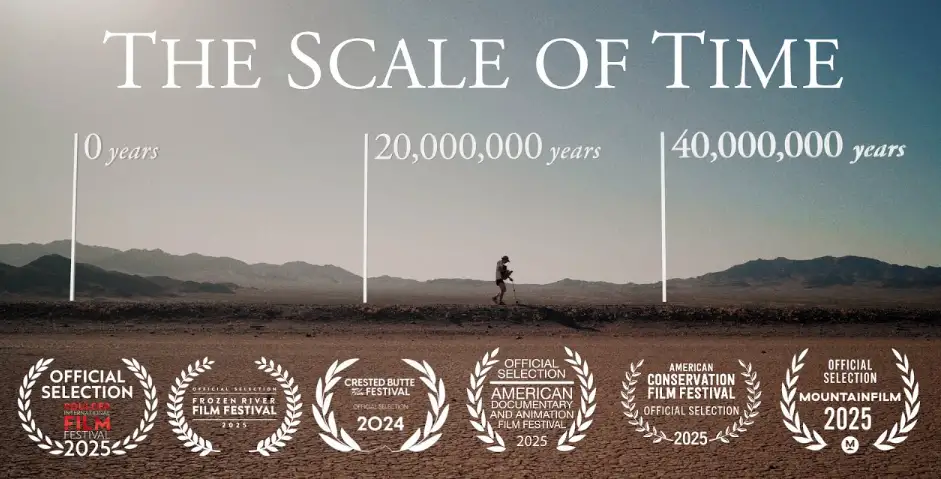
What Is To Scale: TIME by Alex Gorosh?
To Scale: TIME is a short science documentary that presents a physical model of the universe’s 13.8-billion-year history. The filmmakers use a long stretch of desert landscape to represent cosmic time, placing illuminated markers along a carefully measured line.
The central idea is straightforward: if the entire history of the universe could be compressed into a measurable distance, where would important events—including the formation of Earth, the emergence of life, the extinction of dinosaurs, and the appearance of human civilization—actually fall?
The filmmakers turn this question into a practical experiment.
Instead of presenting the universe’s history as a conventional animated timeline, they create a physical installation that allows viewers to appreciate the enormous differences between cosmic, geological, evolutionary, and human timescales.
The project was created by Alex Gorosh and Wylie Overstreet, the filmmaking team also responsible for To Scale: The Solar System. Their work explores the challenge of representing astronomical distances and scientific concepts through real-world scale models.
The film was released in May 2023 and has subsequently appeared in international film festival programs, including Mountainfilm.
The central message: Human beings occupy an extraordinarily small fraction of cosmic history, but the briefness of our existence does not make our lives meaningless. It makes the time we have particularly valuable.YouTube+2
How the Film Turns 13.8 Billion Years Into a Physical Distance
One of the most impressive aspects of To Scale: TIME is its use of physical distance to communicate an abstract scientific concept.
The filmmakers established a timeline approximately 4.3 miles (6.9 kilometers) long across a dry lakebed in the Mojave Desert. Along this distance, small illuminated markers represent selected moments in the universe’s history.
The scale was designed so that approximately every 10 meters represented 20 million years.
This makes the timeline easier to interpret:
- The beginning of the universe is represented at one end.
- The formation of stars and galaxies appears along the early timeline.
- The formation of our solar system and Earth occurs much later.
- The development of life occupies a relatively small portion near the end.
- Human civilization appears extremely close to the present-day endpoint.
The physical distance makes something that is difficult to understand mathematically immediately visible.
Understanding the film’s scale
| Measurement | Approximate representation |
|---|---|
| Total cosmic history | 13.8 billion years |
| Physical timeline | 4.3 miles |
| 10 meters | 20 million years |
| 1 meter | 2 million years |
| 1 centimeter | 20,000 years |
| 80-year human lifespan | 0.04 millimeters |
These figures are approximate and depend on the model’s chosen scale.
The most striking comparison is the final one. An 80-year human lifespan would occupy approximately 40 micrometers along this timeline—roughly comparable to the width of a fine human hair.
In other words, the entire life of an individual becomes an almost invisible mark when compared with the age of the universe.
This is the visual insight that makes the documentary so effective: viewers no longer need to imagine billions of years as an abstract number. They can see the relationship between cosmic history and their own existence.Squarespace+2
The History of the Universe: From the Big Bang to Human Civilization
To understand the film’s message, it helps to examine the major scientific milestones represented by the timeline.
The universe did not develop all at once. Its history involves successive stages of expansion, cooling, star formation, chemical enrichment, planetary formation, biological evolution, and eventually the emergence of human beings.
Stage 1: The Big Bang – Approximately 13.8 Billion Years Ago
The timeline begins with the Big Bang, the scientific model describing the universe’s early evolution from an extremely hot, dense state.
According to NASA, the universe is approximately 13.8 billion years old. During its earliest stages, it expanded and cooled, allowing fundamental particles and eventually atoms to form.
The earliest universe was dominated by hydrogen and helium. Over time, gravity brought matter together, creating the conditions for the first stars and galaxies.
Importantly, the Big Bang should not be understood simply as an explosion occurring at one location in pre-existing space. It describes the expansion of space itself from an earlier hot, dense state.
Stage 2: The Formation of Stars and Galaxies
As the universe evolved, matter gathered under gravity to form increasingly complex structures.
The first stars became important factories for producing heavier chemical elements through nuclear processes. When massive stars reached the end of their lives, some released newly formed elements into surrounding space.
These materials eventually contributed to later generations of stars, planetary systems, and the chemical ingredients needed for life.
This process is fundamental to understanding our origins. The elements found in the human body, including carbon, oxygen, calcium, and iron, have connections to earlier generations of cosmic processes.
Stage 3: The Formation of the Solar System and Earth – Approximately 4.6 Billion Years Ago
Approximately 4.6 billion years ago, our solar system began forming from a cloud of gas and dust.
Gravity caused material to collect around the young Sun, while the remaining material gradually formed planets, moons, asteroids, and other objects.
Earth emerged as a developing planet approximately 4.5 billion years ago.
However, the early Earth was very different from the world we inhabit today. Its surface experienced intense geological activity and frequent impacts from space objects. Over hundreds of millions of years, the planet developed conditions that eventually supported life.
On the 13.8-billion-year timeline, Earth’s formation occurs remarkably late.
NASA identifies the formation of Earth and the solar system as approximately 4.6 billion years ago, meaning our planet did not exist during roughly the first two-thirds of cosmic history.NASA Science+2
Stage 4: The Emergence of Life on Earth
Once Earth developed suitable environmental conditions, biological processes eventually emerged.
Scientists continue to investigate exactly how life originated, and important questions remain unresolved. However, geological and biological evidence indicates that life existed on Earth billions of years ago.
Early organisms were microscopic and relatively simple compared with modern plants and animals.
Over immense periods, biological evolution produced increasingly diverse forms of life. Photosynthetic organisms transformed Earth’s atmosphere by releasing oxygen, contributing to major changes in the planet’s chemistry.
Later, complex cells and multicellular organisms emerged, eventually giving rise to the extraordinary diversity of life visible today.
This section of the timeline demonstrates an important distinction: the existence of a habitable planet and the appearance of complex organisms were separated by billions of years of biological and environmental development.
Stage 5: Dinosaurs, Mass Extinction, and Mammalian Evolution
Dinosaurs appeared approximately 230 million years ago and dominated many terrestrial ecosystems for a substantial part of Earth’s history.
Their reign ended in a major mass extinction event approximately 66 million years ago, associated with the impact of a large asteroid near what is now Mexico’s Yucatán Peninsula.
Although numerous species disappeared, some lineages survived. Mammals diversified significantly in the ecosystems that developed after the extinction.
Over subsequent evolutionary periods, primates and eventually human ancestors emerged.
The timeline helps viewers understand that dinosaurs and humans were separated by an enormous amount of geological time. Human beings did not simply appear after dinosaurs disappeared; their evolutionary history involved millions of years of subsequent biological change.
Stage 6: The Emergence of Homo sapiens
According to the Smithsonian Institution’s Human Origins Program, Homo sapiens evolved in Africa approximately 300,000 years ago.
Early modern humans lived as hunter-gatherers, developed increasingly sophisticated tools, adapted to changing environments, and gradually spread across the world.
Over time, human societies developed language, cultural traditions, technologies, and systems of knowledge.
Approximately 12,000 years ago, the development of agriculture transformed human societies. Food production encouraged permanent settlements, population growth, and eventually the development of towns and cities.
Writing, organized institutions, scientific discovery, industrialization, and modern technology followed.
Yet all of these developments occupy an extraordinarily small section of the universe’s history.인간 기원 프로그램+2
Why Human History Appears Almost Invisible on the Timeline
This is arguably the most powerful scientific insight in To Scale: TIME.
Modern human beings often measure history through familiar reference points:
- A person’s lifetime: approximately 70–90 years.
- A century: 100 years.
- Recorded human history: several thousand years.
- Agricultural civilization: approximately 12,000 years.
- The existence of Homo sapiens: approximately 300,000 years.
These periods may seem substantial when considered within human society. However, they become almost insignificant when compared with 13.8 billion years.
Consider the following comparison:
| Historical period | Approximate duration |
|---|---|
| Age of the universe | 13.8 billion years |
| Age of Earth | 4.54 billion years |
| Age of dinosaurs’ reign | About 165 million years |
| Existence of Homo sapiens | About 300,000 years |
| Agricultural societies | About 12,000 years |
| Recorded written history | About 5,000 years |
| One human lifetime | About 80 years |
The contrast becomes even more interesting when we consider how recently modern civilization emerged.
If the entire history of the universe were represented by a 4.3-mile line, the history of Homo sapiens would occupy only a tiny fraction near the end.
An individual human life would be smaller still.
The difference between human time and cosmic time
Human perception is naturally centered on immediate experiences. We understand time through birthdays, relationships, education, work, aging, and the passage of generations.
Cosmic time operates on a completely different scale.
A geological transformation that takes millions of years may be effectively invisible within a human lifetime. A star can exist for billions of years, while human societies can undergo extraordinary changes within only a few centuries.
The documentary makes this difference tangible by replacing abstract numbers with measurable distance.
It also helps explain why scientific concepts such as evolution, geological change, and stellar development require different timescales from those used in everyday life.
Behind the Scenes: How Alex Gorosh and Wylie Overstreet Built the Model
The visual impact of To Scale: TIME is supported by an ambitious practical production process.
The project took approximately five years to develop. Alex Gorosh and Wylie Overstreet wanted to create something more meaningful than a conventional digital animation: a real-world representation that could communicate the scale of cosmic history through physical space.
Their solution was to use a long stretch of the Mojave Desert as a canvas.
The production involved several practical challenges.
1. Measuring an enormous timeline
The filmmakers needed to establish a consistent distance scale across several miles of open desert. Each marker had to represent the correct interval of cosmic time.
2. Installing illuminated markers
Small LED lights were placed along the measured route to make the timeline visible from above.
3. Coordinating the production team
The crew needed to install and illuminate the markers efficiently. The work involved an assembly-line approach, with team members preparing and positioning lights along the route.
4. Capturing the entire timeline
Aerial filming was essential. Drone footage allowed the filmmakers to reveal the length of the installation and show how the individual lights formed one continuous visual representation.
5. Working within a narrow filming window
The filmmakers faced a lighting challenge. They needed enough remaining natural light to reveal the desert landscape while ensuring the LED markers were bright enough to stand out.
The resulting aerial sequence is especially effective because it combines an actual physical installation with cinematic presentation.
This is not simply a computer-generated illustration of the universe. It is a carefully constructed educational model filmed in a real environment.
The production details also demonstrate how scientific communication can benefit from collaboration between filmmakers, designers, researchers, and technical crews.Squarespace+2
What Does To Scale: TIME Teach Us About the Meaning of Life?
Beyond astronomy, the documentary raises a philosophical question:
If human life occupies such a tiny fraction of the universe’s history, what should we do with the time we have?
The film does not attempt to provide a definitive philosophical or religious answer. Instead, it uses scientific perspective to encourage viewers to reconsider the importance of their own lives.
There are several ways to interpret this message.
1. Human existence is extraordinary in its historical context
The universe existed for billions of years before Earth formed. Life developed through complex biological processes, and eventually a species emerged capable of studying the universe itself.
Human beings can observe distant galaxies, investigate the origins of stars, reconstruct ancient ecosystems, and develop scientific theories about cosmic evolution.
The ability to understand our own origins is remarkable.
2. Time is a limited resource
An individual cannot control the age of the universe or the duration of geological processes.
However, people can make decisions about how they use their available time.
Relationships, learning, meaningful work, creativity, family, and contributions to society are all areas in which individuals can direct their attention and effort.
The documentary encourages a shift from measuring life exclusively through its length to considering the quality and significance of the experiences within it.
3. Perspective can change everyday priorities
Many everyday concerns feel overwhelming when viewed in isolation.
A broader perspective does not mean that personal difficulties are unimportant. It can, however, help people distinguish between temporary frustrations and the things that deserve lasting attention.
For example, someone approaching retirement might reconsider how much time to devote to work compared with relationships, personal interests, or experiences they have postponed.
Similarly, a younger person might recognize the value of learning, exploring, and building meaningful connections rather than focusing exclusively on immediate achievements.
These are practical interpretations of the film’s central message, rather than scientific conclusions.
4. Individual lives contribute to a much larger human story
Although one lifetime is brief, its influence does not necessarily end when that lifetime ends.
Scientific discoveries, works of art, educational contributions, cultural traditions, and acts of kindness can influence people across generations.
Human civilization is built through the accumulated efforts of individuals whose lives were also brief when measured against cosmic history.
This is another way to understand the film’s perspective: the smallness of an individual does not eliminate the possibility of meaningful influence.
Why To Scale: TIME Is an Excellent Example of Science Communication
Scientific information can be difficult to communicate when it involves numbers outside everyday experience.
For example, telling someone that the universe is 13.8 billion years old provides a factual measurement, but it does not necessarily help that person understand its magnitude.
To Scale: TIME addresses this challenge through visual storytelling.
Its approach demonstrates several effective principles of science communication.
| Communication principle | How the film applies it |
|---|---|
| Visual learning | Converts abstract time into physical distance |
| Scale comparison | Relates cosmic history to human experience |
| Practical demonstration | Uses a real desert installation |
| Narrative structure | Follows the development of the universe |
| Emotional engagement | Connects scientific understanding with human reflection |
| Accessibility | Explains complex ideas without requiring advanced astronomy knowledge |
Why physical models are effective
Physical models allow people to understand relationships that are difficult to visualize.
A conventional textbook may explain that Earth is approximately 4.5 billion years old. A physical timeline makes it possible to see how far along the universe’s history Earth actually appears.
The same educational principle applies to other scientific topics:
- Scale models of the solar system help explain planetary distances.
- Geological timelines help students understand evolution and extinction.
- Molecular models help explain chemical structures.
- Population graphs help illustrate demographic change.
- Climate visualizations help explain long-term environmental trends.
The strength of these tools lies in making relationships visible rather than relying exclusively on numerical explanations.
For educators, To Scale: TIME can therefore serve as a useful starting point for lessons involving astronomy, physics, biology, mathematics, geological history, and science communication.
Who Should Watch To Scale: TIME?
The film is particularly suitable for viewers who want to understand the universe without watching a lengthy scientific documentary.
Recommended audiences include:
Students and teachers: The film offers a practical introduction to cosmic history, scientific measurement, and the concept of scale.
Astronomy enthusiasts: It provides a different perspective on the Big Bang, stellar evolution, planetary formation, and the emergence of life.
Documentary lovers: Its combination of real-world construction, aerial cinematography, and scientific storytelling makes it an engaging short-film experience.
Parents and families: It can encourage discussions about Earth’s history, human evolution, and the relationship between people and the natural world.
People interested in philosophy and personal reflection: The film offers a starting point for thinking about mortality, purpose, priorities, and the limited time available to each person.
The film is approximately 10 minutes long, making it an accessible viewing experience even for people with limited time.
To Scale: TIME vs. To Scale: The Solar System
Alex Gorosh and Wylie Overstreet have explored similar ideas through more than one film.
Their earlier project, To Scale: The Solar System, was released in 2015 and used a physical model to demonstrate the actual distances between planets.
To Scale: The Solar System (2015)
Explores the enormous distances between the Sun and planets through a physical desert installation.
To Scale: TIME (2023)
Explores 13.8 billion years of cosmic history through an illuminated timeline.
Although both films use physical scale models, they investigate different dimensions of the universe.
| Feature | The Solar System | TIME |
|---|---|---|
| Main subject | Astronomical distance | Cosmic history |
| Scientific focus | Planetary astronomy | Cosmology and evolution |
| Visualization | Physical planetary positions | Physical timeline |
| Filmmakers | Alex Gorosh and Wylie Overstreet | Alex Gorosh and Wylie Overstreet |
| Release | 2015 | 2023 |
Together, these films demonstrate how physical models can help people understand scientific concepts that are otherwise difficult to imagine.
Conclusion: A Tiny Moment in an Extraordinary Universe
To Scale: TIME by Alex Gorosh and Wylie Overstreet is more than a documentary about the age of the universe. It is an exercise in perspective.
By transforming 13.8 billion years into a physical distance, the filmmakers make an almost unimaginable scientific concept accessible to ordinary viewers. The illuminated markers reveal the extraordinary sequence of events that led from the early universe to stars, planets, living organisms, and eventually human civilization.
The most memorable realization is not simply that humanity arrived late in the universe’s history. It is that everything required to produce our existence—from the formation of stars and the creation of chemical elements to the evolution of life—unfolded across an immense period before we appeared.
Our individual lives may represent only a fraction of a millimeter on this cosmic timeline. Nevertheless, within that brief interval, we have the ability to learn, create, love, explore, and influence the lives of others.
The universe’s history is measured in billions of years. Our personal history is measured in decades.
Perhaps the most valuable lesson of To Scale: TIME is that the significance of a life cannot be measured by its length alone.
We cannot choose how much time the universe has existed, but we can make meaningful choices about the time we have.










An extraordinary and thought-provoking journey through 13.8 billion years of cosmic history. Alex Gorosh brilliantly transforms the unimaginable scale of time into a visual experience that makes us reflect on the birth of the universe, the evolution of life, and humanity’s tiny place in the grand story of existence. Truly fascinating and inspiring!